Last updated:
UAE gratuity is the end-of-service payment your employer owes you when your job ends. Most people know the headline: roughly 21 days’ pay for each of your first five years, then 30 days a year after that.
What far fewer people know is that two of the most widely repeated rules about it are no longer law. Resigning no longer cuts your gratuity. And being dismissed for misconduct does not cancel it under the current law, although lawful deductions can still apply. Both old rules came from the 1980 law, which was replaced in February 2022, yet many articles still repeat them.
This guide sets out what Federal Decree-Law No. 33 of 2021 and its Executive Regulation actually say. It also flags, honestly, the handful of points where the sources genuinely disagree, so you know which figures to rely on and which to check.
Want a quick estimate first? Use our free UAE gratuity calculator, then read on for the rules behind the figure.
Who these rules apply to
Everything below covers private-sector employees on the UAE mainland, working under contracts registered with the Ministry of Human Resources and Emiratisation (MoHRE).
Several groups fall outside it. DIFC and ADGM run their own employment regimes, and we cover both briefly further down. Domestic workers sit under separate legislation entirely. Government employees follow civil service rules instead.
One caveat applies throughout. The English versions of UAE legislation circulating online are translations, and the Arabic original governs wherever the two differ.
Do you qualify for UAE gratuity?
Article 51 sets one condition: you must complete at least one year of continuous service with the same employer. Below that, you earn nothing, no matter why the job ended.
Once you pass a year, however, the entitlement is yours. Article 51 does not make it conditional on who ended the contract or why.
Days of unpaid absence do not count toward your service total. So a long stretch of unpaid leave shortens the period that earns gratuity. Our guide to annual leave in UAE explains how the different leave types work.
How UAE gratuity is calculated
The two tiers
Article 51 sets two rates, and they stack rather than replace each other:
- Years 1 to 5: 21 days’ basic wage for each year.
- Every year after the fifth: 30 days’ basic wage for each year.
The higher rate is not retroactive. Crossing the five-year mark does not upgrade your earlier years. Instead, your first five years stay at 21 days each, and only the years beyond five earn 30.
So someone leaving after eight years earns 105 days for years one to five, plus 90 days for years six to eight — 195 days in total.
Which salary the calculation uses
This is the single most misstated fact about UAE gratuity, so it is worth stating plainly. The calculation uses your basic wage only — the salary figure written into your employment contract.
Housing, transport and every other allowance drop out of the sum entirely. Article 51 bases the calculation on your last basic wage, not your total package.
That matters enormously in the UAE, where packages often weight heavily toward allowances. Two people on an identical AED 20,000 monthly package can end up with very different gratuity, purely because one contract sets basic at AED 12,000 and the other at AED 7,000.
For that reason, the basic salary line is one of the most important things to check before you sign. Our guide on what to check in a UAE job offer letter covers it, and our guide to what counts as basic salary vs allowances shows which other entitlements use your basic figure.
Worked examples
Before the numbers, one honest caveat. To turn a monthly salary into a daily rate, almost everyone divides by 30. That is standard market practice rather than a formula written into Article 51, so treat the results below as illustrations rather than exact entitlements. Ask your HR team which divisor your contract applies.
All three examples use invented figures.
| Example | Basic wage | Service | Days earned | Illustrative gratuity |
|---|---|---|---|---|
| A | AED 8,000 | 3 years | 63 (3 × 21) | AED 16,800 |
| B | AED 15,000 | 8 years | 195 (105 + 90) | AED 97,500 |
| C | AED 6,000 | 1 year | 21 (1 × 21) | AED 4,200 |
Example B shows the tiers combining. Fatima earns 21 days for each of her first five years, which gives 105 days, then 30 days for each of years six, seven and eight, which adds 90. At a daily rate of AED 500, her 195 days come to AED 97,500.
Employers generally pro-rate partial years once you pass the one-year threshold. However, the sources describing exactly how that pro-rating works are not consistent — some suggest a months-out-of-twelve method, others a days-out-of-the-year method. Because the two produce slightly different results, we have kept the examples above to whole years rather than publish a formula we cannot verify against the statute.
The two-year cap
Article 51 caps total gratuity at the equivalent of two years’ wage.
Here the sources genuinely split. Some read the cap as two years of basic wage, mirroring the base used for the calculation itself. Others read it as two years of total wage including allowances, on the basis that the capping clause uses the broader word. We cannot resolve that from the available English texts, so we are not going to pretend otherwise.
In practice the distinction rarely bites, because the cap only comes into play after very long service with one employer. If you are approaching it, though, get the wage base confirmed in writing before you sign any settlement.
Does resigning reduce your gratuity?
No. Not under the current law.
This is the most consequential correction in this guide. Under the old Federal Law No. 8 of 1980, resigning before you had built up enough service could cut your gratuity to a fraction of the full amount. That rule shaped how a generation of UAE employees thought about quitting.
Federal Decree-Law No. 33 of 2021 repealed it. Article 51 contains no resignation-based reduction at all. Once you have completed a year of service, you receive the same gratuity whether you resigned or your employer terminated you.
Even so, a large amount of content online still describes the old fractions as current, and some of it sits on otherwise reputable sites that simply have not updated since 2021. If an article tells you resigning early will cost you part of your gratuity, check whether it is citing article numbers from the 1980 law.
Our guide to resignation in UAE covers the notice period and final settlement side of leaving voluntarily.
Can you lose gratuity if you are dismissed for misconduct?
No. Under the current law, dismissal for misconduct does not by itself cancel your gratuity, which surprises many people, including some HR departments.
Article 44 lets an employer dismiss without notice on specific grounds, following a written investigation. Those grounds include false documents or impersonation, breaching written and displayed safety instructions, assault at work, and extended unexplained absence, among others.
Critically, though, the official English text of Article 44 does not mention gratuity at all. The entitlement comes from Article 51, which gives a worker who completes one year or more of continuous service an end-of-service gratuity and contains no exclusion for misconduct. Under the old law, this kind of dismissal wiped gratuity out; the 2021 law dropped that rule. Article 39 goes further: where dismissal is imposed as a disciplinary sanction, the law expressly preserves the worker’s gratuity. The Arabic text governs, so if you are in a dispute, confirm your position with MoHRE or a UAE employment lawyer.
So an employer cannot withhold your gratuity simply because it dismissed you for cause. It may still deduct amounts you owe under the law or a court judgment, within the categories below — but that is recovery of specific sums, not forfeiture because of how the job ended.
What your employer may lawfully deduct
Article 29 of the Executive Regulation, Cabinet Resolution No. 1 of 2022, sets out the lawful categories. Broadly, an employer may deduct:
- Loans you owe the employer, or amounts it paid you in excess
- Pension or insurance contributions you were legally required to pay
- Fines for workplace violations under the employer’s MoHRE-approved penalty list
- Debts ordered by a court
- The cost of repairing damage to the employer’s tools, equipment or goods caused by your mistake or by breaking its instructions (for this and violation fines, the amount generally must not be more than three months past its due date, unless agreed otherwise)
Notice what is missing from that list. Recruitment fees, visa costs, medical expenses and uniforms do not appear, and employers cannot lawfully withhold them from your gratuity.
That point matters for a wider reason. UAE law places recruitment costs on the employer, not the candidate. If anyone asks you to pay for a job, a visa or a placement, treat it as a warning sign and verify the employer before going further.
When your gratuity must be paid
Article 53 gives your employer 14 days from the end of your contract to settle your end-of-service entitlements.
That deadline covers the whole final settlement, not gratuity alone. Accrued annual leave, outstanding wages and any pay in lieu of notice all fall inside the same window.
If your employer does not pay
Start with a MoHRE labour complaint. MoHRE handles disputes directly up to a monetary threshold and refers larger or unresolved claims toward the courts.
Before you sign anything, read it carefully. Employees sometimes sign a clearance or settlement document before the money actually arrives, which makes recovering a shortfall considerably harder afterwards.
You have two years to claim, not one
This figure is probably the most commonly wrong number in UAE employment content, so it deserves its own section.
The current limitation period is two years from the date your employment relationship ended, under Article 54(9) as amended by Federal Decree-Law No. 9 of 2024.
Plenty of sources still say one year, and there is a reason so many do. One year was correct under the original 2021 text before the 2024 amendment. One year was also the figure under the repealed 1980 law, though it ran from a different starting point. Three separate “one year” figures therefore circulate, and none of them is current.
Some official pages had not caught up at the time of writing. Because a limitation period decides whether you can claim at all, confirm your own deadline with MoHRE rather than relying on any article, including this one.
The alternative savings scheme
Since 2023 the UAE has run a voluntary alternative to traditional gratuity, established by Cabinet Resolution No. 96 of 2023 and administered by MoHRE with the Securities and Commodities Authority.
Instead of accruing a lump sum payable at the end, your employer pays monthly contributions into an approved investment fund. Independent advisory firms report the employer contribution rates as 5.83% of basic monthly salary for employees with under five years of service, rising to 8.33% after that. Those percentages mirror the 21-day and 30-day accrual rates almost exactly.
Three points matter if your employer raises it:
- Joining is voluntary for employers, but once your employer enrols your category, participation becomes mandatory for you.
- The scheme preserves any gratuity you accrued before enrolment and fixes it at your enrolment-date salary. You do not lose it.
- When you leave, you can withdraw the accumulated contributions and investment returns, or leave the funds invested.
Since this scheme is still relatively new and the detail sits in a Cabinet Resolution rather than the Labour Law, confirm the current rates and terms with your employer and MoHRE before you agree to switch.
Part-time and other work models
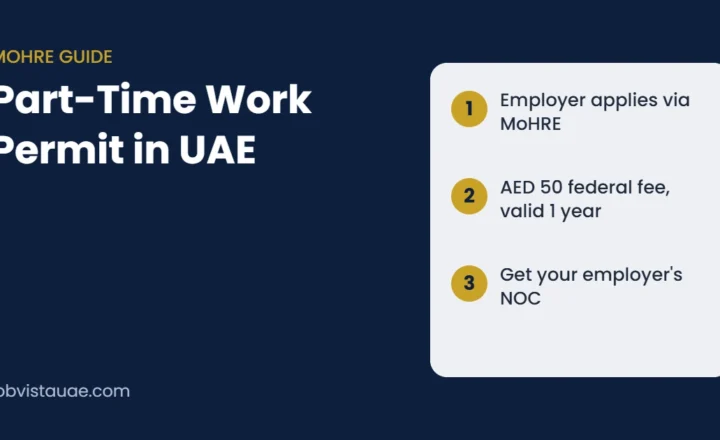
The Executive Regulation pro-rates gratuity for part-time workers by hours. You divide your contracted annual hours by a full-timer’s annual hours, turn that into a percentage, and apply it to what the full-time gratuity would have been.
So a part-timer contracted for 1,000 hours a year, against a full-time year of 2,000 hours, earns 50% of the full-time figure. The same one-year minimum service rule still applies.
Part-time employees may also work for more than one employer with Ministry approval, in which case each employment relationship generates its own separate gratuity calculation.
Free zones, DIFC and ADGM
Most free zones follow the federal Labour Law, so the Article 51 formula above applies. The two financial free zones do not.
DIFC replaced end-of-service gratuity with DEWS, a funded workplace savings scheme into which employers pay monthly contributions. ADGM kept a traditional accrual gratuity closely resembling the mainland formula, while allowing employers to offer a pension or savings scheme as an alternative that employees can choose instead.
Both operate under their own regulations and their own courts. If you work in either, check your own rulebook rather than applying the mainland figures here.
Six claims about UAE gratuity that are out of date
Each of the following still circulates widely. None reflects the current law.
- “Resign early and you lose part of your gratuity.” Repealed in 2021. Article 51 has no resignation reduction.
- “Dismissal for misconduct wipes out your gratuity.” Article 44 does not mention gratuity, and Article 51 contains no misconduct exclusion. Lawful deductions still apply.
- “Unlimited contracts have different gratuity rules.” The limited and unlimited distinction no longer exists on mainland contracts. All are fixed-term now.
- “You have one year to bring a claim.” Two years, from the end of the employment relationship, since the 2024 amendment.
- “Gratuity is calculated on your total salary.” Basic wage only. Allowances do not count.
- “Your employer can deduct visa and recruitment costs.” Those fall outside the lawful deduction categories.
A useful test: if an article cites article numbers in the 120s or 130s, it is quoting the 1980 law, which no longer exists. The current law runs to 74 articles.
Frequently asked questions
How is UAE gratuity calculated?
You earn 21 days of basic wage for each of your first five years of service, then 30 days of basic wage for each year after that, up to a ceiling of two years’ wage. The calculation uses basic salary only, not your total package.
Do I get gratuity if I resign?
Yes, in full, provided you completed at least one year of continuous service. Under Federal Decree-Law No. 33 of 2021, resignation and employer termination produce identical gratuity.
Is gratuity calculated on basic salary or gross salary?
Basic salary. Article 51 bases the calculation on your last basic wage, which excludes housing, transport and other allowances.
How long does my employer have to pay my gratuity?
Fourteen days from the end of your contract, under Article 53. That window covers your whole final settlement, including accrued annual leave.
Do I get gratuity after only one year?
Yes. One year of continuous service is the threshold, and completing it earns you 21 days of basic wage. Below one year, you earn nothing.
Where to check the law yourself
Always prefer primary sources to summaries, this one included. Start with the Ministry of Human Resources and Emiratisation, the official UAE Government guide to end-of-service benefits, and the UAE legislation portal’s record of Federal Decree-Law No. 33 of 2021.
Be careful with third-party gratuity calculators. Many describe themselves as MoHRE-compliant without any connection to the Ministry, and some still apply the repealed 1980 formulas.
Before you sign your final settlement
Gratuity rewards length of service, and under the current law few other things change the figure. Resigning does not reduce it, and dismissal does not by itself cancel it, although the Arabic text governs and a dispute is worth checking with MoHRE or a lawyer. Your basic wage, your years of service and any lawful deductions are what count.
Three habits will protect the money. First, check the basic salary line before you sign a contract, because that single number drives everything here. Second, work out your own figure before you accept a settlement. Third, never sign a clearance document until the payment has actually reached you.
Ready for the next move? Browse the latest UAE job vacancies on JobVista UAE, or explore more UAE career guides to prepare.
This guide provides general information about UAE employment law and is not legal advice. We checked every figure and provision in September 2026, and the law changes. For a decision affecting your own contract or settlement, consult MoHRE or a qualified UAE employment lawyer.