
Last updated:
The UAE CV format is not the same as the format that works in London or New York. Some standard advice travels well to the Gulf, such as keeping it short, leading with results and tailoring every application. However, plenty of it does not travel at all.
Consider what a recruiter here is actually doing. In Dubai or Abu Dhabi, one person is often shortlisting candidates from a dozen countries, on several visa types, and at the same time weighing very different joining dates. As a result, your CV has to answer questions a UK employer would never think to ask. If it does not, a strong profile can be passed over for an administrative reason that has nothing to do with your ability.
This guide breaks the UAE CV format down section by section: what belongs in your personal details, how to write a visa status line that helps rather than hurts you, and finally the length and file rules that decide whether your CV gets opened at all.
What Makes the UAE CV Format Different
In particular, three things shape hiring here, and each one changes what your CV needs to say.
Availability Is Part of the Assessment
Employers need to know when you can actually start, and also what paperwork sits between you and a desk. In the private sector, the notice period must be at least 30 days and no more than 90 days under Article 43 of the UAE Labour Law. Therefore, a candidate already inside the country on a cancelled visa can often join months earlier than one still serving notice. Indeed, that difference alone decides shortlists.
Applicant Pools Are Large and International
A single vacancy in Dubai can attract hundreds of applications, especially from South Asia, the Levant, Africa, Europe and the Philippines. Because of that volume, nobody is reading closely on the first pass. Your first screen is a scan, so structure is what survives it.
Personal Details Are Still Commonly Requested
Nationality, date of birth and a photo appear on a large share of CVs circulating in the UAE market. Still, that is convention rather than law. Article 4 of the UAE Labour Law prohibits discrimination on grounds including race, colour, sex, religion, national or social origin and disability, and it applies to recruitment as well as to employment itself. Once you know that, you can decide what to include on your own terms instead of out of habit.
The Standard UAE CV Format, Section by Section
In short, this is the UAE CV format running order most recruiters are used to reading. You can move things around, but the top third of page one should always answer who you are, what you do and when you can start.
| Section | What it does | Include it? |
|---|---|---|
| Personal details | Name, contact, location | Always |
| Visa status and availability | Answers the eligibility and start-date question | Always |
| Professional summary | Three or four lines positioning you for this role | Always |
| Work experience | Reverse chronological, with results | Always |
| Education | Qualification, institution, country, year | Always |
| Skills | Technical and soft skills matched to the ad | Always |
| Certifications and licences | Professional registration, safety cards, software | If relevant |
| Languages | English, Arabic and others, with honest levels | Recommended |
| References | Names and contacts, or a single line | Optional |
Personal Details: What to Include and What to Leave Out
Above all, keep this block tight. Four or five lines at the top of page one is usually enough, so resist the urge to add more.
Always Include
- Your full name, spelled exactly as in your passport, because HR will match it against your documents later
- One mobile number in international format, starting +971 if you are already in the UAE
- A professional email address that you actually check daily, since recruiters often call only once
- Your current city and country, such as Dubai, UAE
- A LinkedIn URL, but only if the profile is current and matches your CV
Leave Out
- Your full residential address, because a city is all anyone needs at this stage
- Passport number, Emirates ID number and visa file number, even if a form asks for them
- Your current or expected salary, since naming a figure this early only limits you
- Scanned copies of certificates or your passport page, unless the employer specifically requests them
The identity documents matter most here. In fact, a CV posted to job boards travels further than you think, since passport or Emirates ID numbers are exactly what impersonation schemes need. Because of that, a genuine employer only asks for them once an offer is being prepared and a work permit is being applied for. So if a recruiter wants them earlier, take a few minutes to verify the employer before sharing anything.
Salary is worth leaving off for a different reason. If you name a figure in writing, you set a ceiling before you know how the package is structured. Instead, keep that conversation for the interview, where you can answer the salary expectations question properly.
Should You Put a Photo on a UAE CV?
It is optional, and it is becoming less common. Recruitment agencies still often expect one, particularly in hospitality, retail, aviation and front-of-house roles. However, large corporates and multinationals increasingly prefer CVs without a photo, because image-heavy files are handled badly by screening software.
A simple rule works well here. If the advert asks for a photo, include one: plain background, professional dress, head and shoulders, and taken recently. Otherwise, a clean text-only CV is the safer default for corporate and technical roles.
Nationality, Date of Birth and Marital Status
Nationality is the one most candidates keep, because visa processing and cost genuinely differ by passport, and recruiters are used to seeing it. Date of birth and marital status, on the other hand, add nothing to a hiring decision. So you are free to leave both off, and nobody will reject a CV for omitting them.
How to Write Your Visa Status and Availability
The UAE CV format has one section no UK or US template includes. Even so, it is the first thing many recruiters look for, so give it two lines directly under your contact details.
| Your situation | How to write it |
|---|---|
| Employed in the UAE | Employment visa. Notice period: 60 days. |
| Visa cancelled, still in the UAE | Visa cancelled. Available to join immediately. |
| On spouse or family sponsorship | Family sponsorship. Employer needs to arrange a work permit only. |
| On a visit or tourist visa | In the UAE on a visit visa valid until 12 October 2026. |
| Long-term or Golden Visa holder | Golden Visa holder, self-sponsored. |
| Applying from outside the UAE | Currently in Manila. Available to relocate within four weeks. |
Check your contract before you write a notice period. If you put 30 days on your CV although your contract says 90, that becomes an awkward conversation at offer stage. The law sets the range at 30 to 90 days, and both sides can agree to shorten or waive it, but the starting point is always whatever you signed.
One clarification saves a lot of confusion. Being on family sponsorship does not mean you can start work without paperwork, because you still need a work permit from the Ministry of Human Resources and Emiratisation. In fact, MoHRE issues 13 different work permit types, depending on your status and where you are. Saying so on your CV therefore signals that you understand the process. If you are unsure which route applies to you, our step-by-step guide to the UAE work visa process walks through it.
Writing a Professional Summary That Earns Its Space
First, three or four lines, positioned directly under your details. It should name your job title, your years of experience, your specialism and, above all, one concrete result. Then skip anything that could appear on any CV in the world.
Weak, because it says nothing:
Hardworking and motivated team player seeking a challenging opportunity in a reputed organisation where I can utilise my skills.
Stronger, because every clause is checkable:
Sales Executive with six years in the UAE FMCG market, covering Dubai and Northern Emirates retail accounts. Grew a 40-outlet territory by 22% over two years. Fluent English and Hindi, working Arabic, valid UAE driving licence.
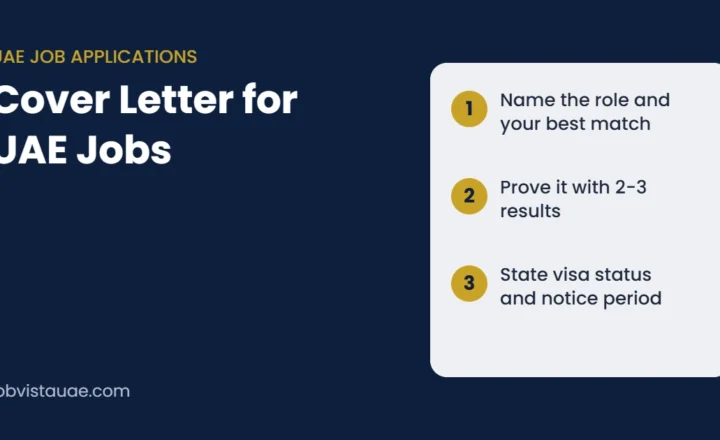
Rewrite this section for each application. Although it takes two minutes, it is the part a recruiter actually reads. If the employer also asks for a cover letter, our guide to cover letters for UAE jobs shows how to keep it short and specific.
Work Experience: Format and Local Detail
List roles in reverse chronological order. For each one, give the job title, company, city and country, and then the month and year range. Next, add three to five bullets, each starting with a verb and ending with a result wherever you have one.
Include the country on every entry. For example, a line reading Sales Executive, Al Faris Trading LLC, Dubai, UAE tells a recruiter immediately that your experience is local, and local market experience carries real weight here. If your experience is from abroad, name the country plainly and let the achievement speak instead.
How to Handle Employment Gaps
Gaps are ordinary in the UAE. Visa cancellations, relocations and periods on dependent sponsorship all create them, so recruiters here see them constantly. Hiding a gap by stretching dates looks worse than the gap itself, because dates get checked against your labour contract history later.
Instead, a single line handles it: Career break, 2025. Relocated to the UAE on spouse sponsorship.
If you have little or no formal experience yet, lead with education, internships, university projects and volunteering, and also keep the CV to one page. Our guide on getting a job in Dubai without experience covers how to build that first page.
Education, Certifications and Professional Licences
Give the qualification, institution, country and year of completion. Once you hold a degree or diploma, there is no need to list school results as well.
Two points specific to the UAE are worth knowing. First, employers commonly ask for attested certificates during onboarding rather than at application stage, so your CV only needs the qualification stated clearly. Second, regulated professions carry their own licensing, particularly healthcare, engineering, accountancy, law and teaching. If you already hold the licence, or you have passed the eligibility assessment, put that on the CV. It removes doubt, and it also shortens the employer’s timeline.
Skills, Languages and Driving Licence
Skills
Split technical and soft skills into two short lists. Then pull the wording from the job advert wherever it honestly matches your experience. However, avoid progress bars, star ratings and percentage graphics, because screening software cannot read them. Besides, a self-awarded four stars out of five means nothing to a hiring manager.
Languages
English is the working language of most UAE private-sector workplaces, so state your level even if it feels obvious. Arabic is a genuine asset for government-facing, legal, HR and customer-facing roles, although it is not a general requirement across the market. In addition, describe your levels honestly using plain words: native, fluent, working knowledge, basic.
UAE Driving Licence
This deserves its own line, especially for sales, logistics, field service, engineering site roles and anything covering multiple emirates. Say whether it is a UAE licence or a home-country licence, since only one of them lets you drive on day one. For driving roles, our guide on how to get a driver job in UAE explains which licence category each job needs.
Length, File Format and File Name
- Length: two pages is standard. However, use one page if you are a fresher, and three only for senior or technical profiles with a genuine project list.
- File type: send a PDF unless the advert specifically asks for Word.
- File name: use Firstname-Lastname-Job-Title.pdf instead of anything called CV Final or Resume New 2.
- Layout: single column, standard fonts and clear headings, so avoid text boxes or tables around your content.
That last point matters more than it looks. Even a well-written CV can be parsed into nonsense inside a two-column designer template, long before a human ever sees it. Therefore, our guide to building an ATS-friendly CV for UAE employers covers the technical side in full.
UAE CV Format Mistakes That Cost Interviews
Most of these look small, but each one costs interviews on its own.
- Sending one identical CV to every vacancy, so nothing matches the advert
- Leaving out visa status, even though you are already in the UAE
- Listing duties instead of results, so every candidate reads the same
- Adding passport or Emirates ID numbers, although no employer needs them at this stage
- Using a non-UAE mobile number without a country code, so nobody can reach you
- Overstating Arabic fluency, since it will not survive the first phone call
- Running to five pages because everything felt important
- Leaving spelling errors in your own job title, particularly in your employer’s name
- Keeping an old school email address, even though you no longer check it
Checklist Before You Send It
Before you attach the file, run through the UAE CV format checklist once.
- First, check your name matches your passport exactly
- Then confirm your phone number includes the country code and is reachable
- Next, make sure your visa status and notice period are stated accurately
- Confirm the professional summary is rewritten specifically for this role
- After that, check experience runs in reverse chronological order with cities and countries
- Match your skills to the advert’s wording, but only where they truthfully apply
- Remove identity document numbers, even from the header or footer
- Finally, save it as a PDF with a professional file name
- Before sending, read it out loud, or ask someone else to check the spelling
Frequently Asked Questions
Is a UK or US CV format acceptable in the UAE?
Yes, with one addition. The structure is close enough, but a UK or US template has no place for the visa status and availability lines the UAE CV format needs. So add those two lines, and it works.
Should I write CV or resume?
In the UAE the two words are used interchangeably for the same two-page document. In fact, job adverts use both. Therefore, there is no practical difference to worry about.
Do I need a different CV for Dubai and Abu Dhabi?
No, because the UAE CV format is the same across all seven emirates. However, what should change between applications is the professional summary and the skills you highlight, since that depends on the role rather than the location.
How long should a UAE CV be?
Two pages suits most candidates. If you are a fresh graduate, one page is better. Otherwise, go to three pages only when a senior or technical role genuinely needs a publication or project list.
Do I have to mention my visa status?
You are not obliged to, but it helps you. Recruiters will ask within the first message anyway, so answering upfront moves you forward faster. It is especially useful if your status is an advantage, such as a cancelled visa or family sponsorship.
Should I include references on my CV?
Not usually. A line saying references are available on request is enough, and it also protects your former managers from unsolicited calls. Still, have two contacts ready for when the employer asks.
Putting It Into Practice
Most CVs that fail in the UAE are not badly written. Instead, they ignore the UAE CV format entirely: they miss the visa and availability information that decides who gets called, and they are laid out in a way that survives neither a six-second scan nor a screening system.
Fix the structure once, and you have a base document you can adapt in a couple of minutes per application. You can also build one with our ATS CV builder. After that, the next step is the interview, so our UAE job interview questions guide covers what employers ask once your CV has done its job. If you are still planning your search more broadly, start with our guide on how to find a job in the UAE.
Finally, when your CV is ready, browse the latest jobs in UAE and apply to the roles that genuinely match your experience.
5 Comments