Most people handle a resignation in UAE employment badly, and it costs them money. They give notice verbally, agree to leave early without putting it in writing, or walk away believing that resigning wipes out their gratuity. None of that is necessary.
Federal Decree-Law No. 33 of 2021 sets out exactly how much notice you owe, what your employer still owes you while you serve it, and how quickly your final money must arrive. This guide covers the rules that apply once you have passed probation, what your settlement should contain, and how to leave without creating problems for your next job.
How much notice do you have to give?
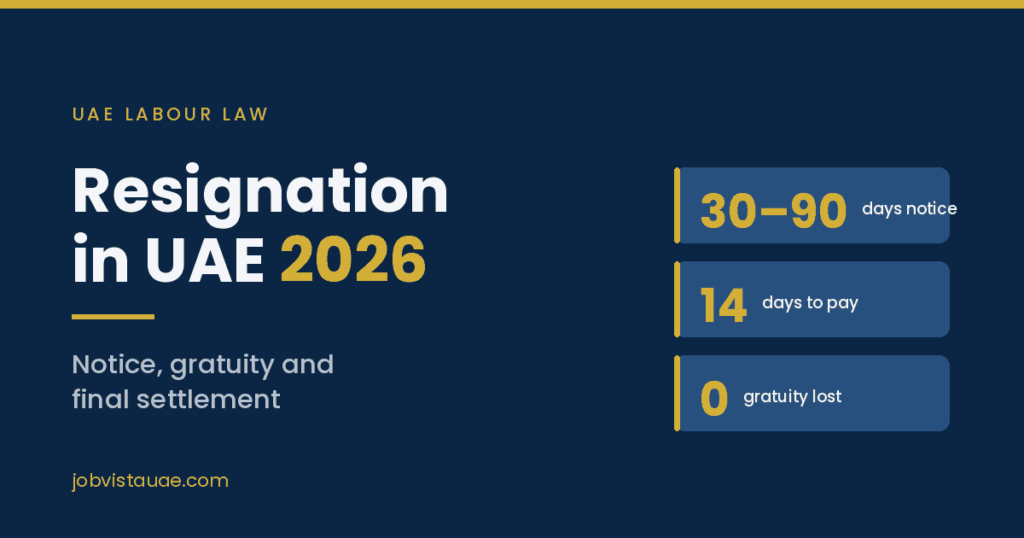
Article 43 sets the range: written notice of not less than 30 days and not more than 90 days. Your contract picks the exact figure inside that band, and the same rule binds both sides.
| Situation | Written notice |
|---|---|
| You resign after probation | Whatever your contract states, between 30 and 90 days |
| Your contract says nothing | 30 days, the statutory minimum |
| Your contract says 120 days | Unenforceable beyond 90 days |
| You are still on probation | Shorter rules apply — see our probation period guide |
Two details catch people out. First, a clause demanding longer notice from you than from your employer does not hold up. The periods must match, unless the difference favours the employee. Second, your notice starts when you hand over a dated, written resignation, not when you mention it in a meeting. Verbal resignations create disputes about dates, and the dates decide your final pay.
Before you write anything, reread the notice clause in your own contract. Our UAE job offer letter checklist explains where that clause usually sits and how it should read.
When you can resign without notice
Article 45 lets you end the contract immediately, with no notice and no penalty, in a narrow set of circumstances. The main grounds are:
- Your employer fails to pay your wages
- Your employer, or someone acting for them, assaults or harasses you
- The workplace puts your safety or health at serious risk and your employer does nothing after being told
- Your employer breaches a material obligation under the contract or the law
These are real protections, but treat them carefully. Document the breach, report it in writing, and keep copies before you rely on any of them. A resignation you later describe as justified will only stand up if you can show what happened and when. If unpaid salary is the issue, our guide to the UAE salary payment rules sets out the deadlines your employer already missed.
You can also skip notice by agreement. If both sides sign something waiving all or part of it, that works too.
What your employer owes you while you serve notice
Resigning does not downgrade your terms. Throughout the notice period you keep your full salary and benefits, and your employer cannot cut your pay or worsen your conditions as a reaction to the resignation.
Employers do have two legitimate options. They can pay you in lieu of notice, ending the job sooner while compensating you for the unserved days. They can also keep you on payroll but away from the workplace. What they cannot do is treat your resignation as effective immediately and simply stop paying you. To end things early they must either compensate you for the remaining notice or get your written agreement to waive it.
Use the time well. Hand over your work properly, return company property, and get written confirmation of your last working day. That single document prevents most settlement arguments later.
Does resigning cost you your gratuity?
No, and this is the most persistent myth in UAE employment.
Under the old pre-2022 law, employees who resigned early received a reduced end-of-service payment. That penalty no longer exists. End-of-service gratuity now follows the same formula whether you resign or your employer ends the contract, based on your basic salary and your years of continuous service.
One exception remains. Where an employer lawfully dismisses someone under Article 44 for serious misconduct, gratuity is not owed. Ordinary resignation falls nowhere near that provision.
Because the calculation runs on basic salary rather than your total package, the split in your contract matters more than most people realise. Our UAE gratuity calculation guide works through the formula, and the UAE salary guide explains why two identical packages can produce very different payouts.
Your final settlement and the 14-day rule
Your employer must pay your full and final settlement within 14 days of your last working day. That figure should include:
- End-of-service gratuity
- Any unpaid salary, overtime or allowances already earned
- Cash for annual leave you accrued but never took
- Payment in lieu of notice, where the employer shortened your notice themselves
Ask for the settlement as an itemised breakdown rather than one lump figure. Errors hide inside totals, and leave encashment is where they hide most often. Check the gratuity line against your own calculation before you sign anything acknowledging receipt.
Labour ban and travel ban are not the same thing
Candidates confuse these constantly, and the confusion causes real anxiety during a resignation.
A labour ban affects work permits. It can block the issuing of a new permit for a period, which matters for your next job. A travel ban is an entirely separate measure that courts or immigration authorities impose for different reasons, and it restricts movement rather than employment. Resigning properly, with notice served and a clean settlement, keeps you clear of the situations that create either one.
Leaving without serving notice is what generates trouble. Your employer can claim compensation for the unserved period, and an unresolved exit complicates the next work permit. Serving the notice is almost always cheaper than not serving it.
If your employer withholds pay or refuses to cancel your visa
You have a route, and it costs nothing to start.
File a complaint with the Ministry of Human Resources and Emiratisation. Either party may raise a complaint within 30 days of the breach. MoHRE then attempts to mediate a settlement, and where claims fall below a set threshold it can issue a binding decision carrying the force of a court order. Larger claims go to the Court of First Instance if mediation fails. While a dispute runs, MoHRE can order an employer to keep paying salary for a limited period.
Bring documents rather than accounts. Your resignation letter, the written confirmation of your last working day, payslips, the settlement breakdown and any correspondence about the delay will carry your case further than a description of events.
Free zone employees follow different rules
Everything above applies to mainland private-sector employment under the federal labour law. Two financial free zones sit outside it.
The DIFC operates its own employment law, and notice there scales with length of service instead of sitting in a fixed 30 to 90 day band. The ADGM applies its own employment regulations. If your contract names either free zone, check that framework rather than assuming the mainland rules cover you, because notice entitlements and exit processes genuinely differ.
How to resign cleanly
A tidy exit takes six steps.
- Confirm your notice period from the registered MoHRE contract, not from memory or from the offer letter alone.
- Secure the new offer in writing first. Resigning on a verbal promise leaves you exposed if the offer changes.
- Submit a dated written resignation stating your intended last working day, and keep a copy you can prove was delivered.
- Agree the handover and ask for written confirmation of the final date.
- Request the settlement breakdown before your last day, so you can query any line while you are still on site.
- Complete the visa cancellation and keep every clearance document. Your next employer will need them.
Resist the urge to disappear on bad terms. The UAE recruitment market is smaller than it looks, reference checks happen, and a clean exit costs you nothing.
Frequently asked questions
What is the minimum notice period for resignation in the UAE?
Thirty calendar days for confirmed employees, in writing. Your contract may set a longer period up to 90 days, but anything beyond 90 days is not enforceable.
Do I lose my gratuity if I resign?
No. Gratuity follows the same formula whether you resign or your employer ends the contract. Only a lawful dismissal for serious misconduct under Article 44 removes the entitlement.
Can my employer make me leave immediately without pay?
No. To end your employment before the notice expires, your employer must either compensate you for the unserved days or obtain your written agreement to waive that notice.
How long does my employer have to pay my final settlement?
Fourteen days from your last working day. The payment should cover gratuity, outstanding wages, unused annual leave and any notice pay owed.
Can I start a new job while serving my notice period?
Your obligations to your current employer run until your last working day, and your work permit remains tied to them until cancellation. Most candidates agree a start date that follows the notice period, or ask their current employer to shorten it in writing.
What happens if I just stop attending work?
Your employer can claim compensation for the notice you failed to serve, and the unresolved exit can complicate your next work permit. Serving notice is almost always the cheaper option.
Leave on paper, not on goodwill
A resignation in UAE employment runs on documents. The dated letter sets your notice clock. The written confirmation fixes your last working day. The itemised breakdown proves what you were owed. Candidates who keep those three things rarely end up in a dispute, and the ones who rely on a friendly conversation frequently do.
Know your notice period, serve it properly, and check every line of the settlement before you sign.
Lining up your next move? Browse the latest jobs in UAE and match your start date to the notice you actually owe.
This guide explains general rules under UAE labour law and is not legal advice. For a decision affecting your own contract, confirm the current position with MoHRE or a qualified UAE employment lawyer.