
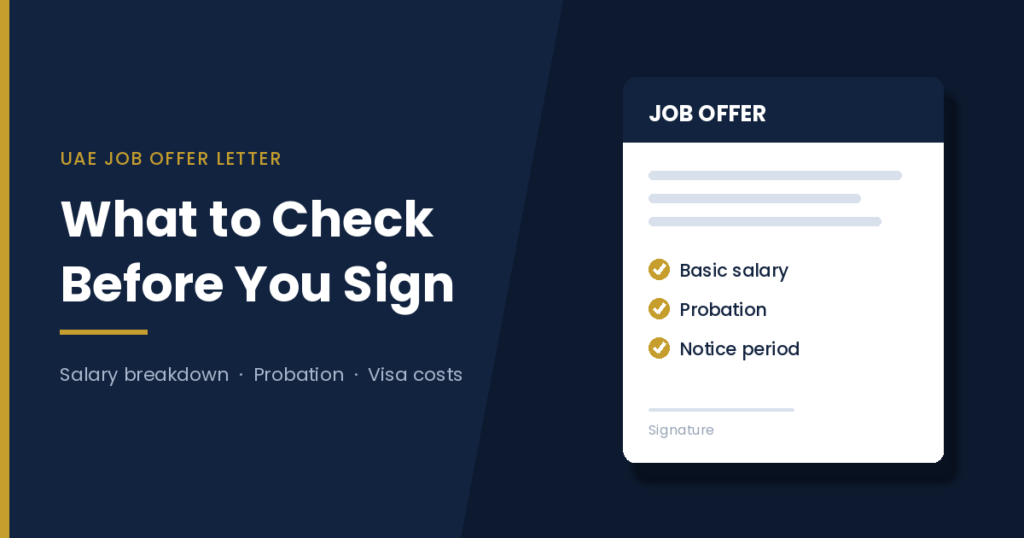
A UAE job offer letter is not a formality. Once you sign it, your employer builds the employment contract from it, and the terms inside it follow you through probation, resignation and your final settlement. Many candidates read the salary figure, feel relieved, and sign the same day.
That is usually where the trouble starts. This guide covers what a UAE job offer letter should contain, which lines deserve a second reading, and what to do when the contract that arrives later does not match what you agreed.
What a UAE job offer letter is under the law
For mainland private-sector roles, the offer is a regulated step rather than a friendly email. The employer prepares a standard job offer through the Ministry of Human Resources and Emiratisation (MoHRE) system and sends it to you for review. Your signed offer then supports the work permit application, and the contract that follows must mirror it.
Federal Decree-Law No. 33 of 2021 governs employment in the UAE private sector, and it took effect on 2 February 2022. Under that law, every private-sector employment contract runs for a fixed term. The older unlimited contract no longer applies to new hires, so an offer that still uses that wording relies on an outdated template.
One step comes before any of this. Confirm that the offer and the employer are genuine, because none of the checks below matter if the company does not exist. Our guide on how to verify a UAE job offer and employer covers that in ten minutes.
The order things happen in
Understanding the sequence tells you when you still have room to negotiate:
- The employer issues the job offer through MoHRE and sends it to you.
- You review it and sign.
- The employer applies for the work permit, plus an entry permit if you join from overseas.
- You complete the medical examination and Emirates ID steps.
- The employer registers the employment contract with MoHRE, and it should reflect the offer you signed.
- Your residence visa comes through and you start work.
Your leverage sits almost entirely at step two. After you sign, any change to the terms needs your consent, but improving them becomes much harder. If the visa side of this process is new to you, the UAE work visa process explained walks through each stage.
Nine things to check on your UAE job offer letter
1. Basic salary shown separately from allowances
This line matters most, and most candidates skim straight past it. UAE offers usually split pay into a basic salary plus allowances such as housing and transport. Two offers with an identical total package can therefore be worth very different amounts, because the law calculates several entitlements on basic salary alone.
If your offer shows a single lump sum with no breakdown, ask for the split in writing before you sign anything.
2. Job title and the actual role
The title on the offer becomes the title MoHRE holds on record, and it affects your work permit category and your future job moves. Check that it matches the role you discussed in your interview. A sales executive title on an offer for a store supervisor role will create friction later.
3. The contract term
Because all private-sector contracts run for a fixed term, the offer should state the duration clearly. Either side may extend or renew that term for a similar or shorter period. If the contract expires and both sides simply carry on working, it continues on the same terms, and any extension counts towards your end-of-service benefits.
4. Probation period
Probation cannot exceed six months, and no employer may extend it for a further term. Notice rules during probation also differ from the rules afterwards:
- Employer ends your employment during probation: it must give you 14 days written notice.
- You resign to join another UAE employer: give at least one month of written notice. Your new employer then compensates the current one for recruitment costs, unless the two sides agree otherwise.
- You resign and leave the UAE: give 14 days written notice. Return within three months on a new work permit, and your new employer may owe those recruitment costs.
An offer that proposes a longer probation, or that lets the employer extend it, does not match the law.
5. Notice period after probation
Once probation ends, your contract sets the notice period, commonly somewhere between 30 and 90 days. Read this line carefully if you expect to move again within a couple of years. A 90-day notice period can cost you an opportunity when another employer needs someone to start quickly.
6. Working hours, overtime and your rest day
Standard working hours in the private sector run to eight hours per day or 48 hours per week. Overtime should not exceed two hours per day, and total working hours should not exceed 144 hours across any three-week period.
Overtime earns your basic hourly wage plus at least 25 per cent, rising to 50 per cent for work between 10pm and 4am. If you work on your weekly rest day, you should receive either a substitute rest day or your basic pay for that day plus 50 per cent. Some sectors and worker categories follow different hour rules, so ask how the employer classifies your role whenever the offer states unusual hours.
7. Annual leave
Each year of service earns you at least 30 days of paid annual leave. Between six and twelve months of service, you earn two days for each month worked. Check whether the offer matches this, and whether it also includes the annual flight allowance many employers provide.
8. Who pays for the permit, medical and visa
The employer does. It carries recruitment costs, the work permit, the medical examination and the residence visa, and the law forbids passing any of that to you. Treat any visa deposit, processing fee or salary deduction for these costs as a reason to stop and ask questions. Legitimate recruitment agencies bill the employer, never the candidate.
9. Non-compete and post-employment restrictions
Employers may include a non-compete clause. However, it must go no further than their business interests genuinely require, and it must specify time, place and type of work. The maximum restriction period runs to two years from the date the contract expires. Query any vague clause that bars you from similar work anywhere in the UAE before you sign.
Why basic salary decides more than the headline figure
The law calculates several entitlements on basic salary rather than your total package, which is why the split deserves so much attention:
| Entitlement | Basis for the calculation |
|---|---|
| End-of-service gratuity | Your last basic salary |
| Overtime pay | Your basic hourly wage |
| Annual leave pay and unused leave at exit | Basic salary |
Consider two offers. The first pays AED 12,000 in total with AED 4,000 basic. The second pays AED 11,500 in total with AED 8,000 basic. Once you count gratuity and leave pay, the lower headline figure usually wins. Our guide to UAE gratuity calculation shows exactly how that gap widens over several years.
If you are still at the negotiation stage, the way you frame numbers matters. Our guide on answering salary expectation questions covers how to discuss the basic salary line rather than only the total.
If the contract does not match the offer
This happens more often than most candidates expect, usually as a lower basic salary or a different job title. The contract on MoHRE’s record should reflect the offer you signed, and material changes need your agreement.
So if the contract differs, do not sign it. Raise the point with the employer in writing first and refer back to the offer you signed. Should that not resolve matters, you can file a complaint with MoHRE. Meanwhile, keep copies of everything: the offer you signed, all correspondence, and the draft contract.
After you start work, your salary should reach you through the Wage Protection System, which gives you a record to compare against your contract. Our article on the UAE salary payment rules explains the timing employers must follow.
Free zone roles follow different rules
The DIFC in Dubai and the ADGM in Abu Dhabi operate their own employment regulations, with different notice period and gratuity arrangements. Many other free zones apply the federal framework instead. Before you rely on the points above, check which authority governs the role, and ask the employer directly whenever the offer does not say.
Questions worth asking before you sign
- What is the basic salary, and what does each allowance cover?
- Does MoHRE or a free zone authority govern this role?
- How long is the notice period after probation?
- Does medical insurance cover me, and can I add my family?
- Does the package include an annual flight allowance?
- When will I receive the MoHRE contract to sign?
Asking these questions is normal, and employers expect it. For more on handling that conversation well, see our guide to questions to ask the employer in a UAE job interview.
Frequently asked questions
Is a UAE job offer letter legally binding?
Once both parties sign the MoHRE job offer, it forms the basis of the employment contract that follows, and that contract should reflect it. Treat it as a commitment rather than an informal step.
Can an employer lower the salary after I sign the offer?
Material terms should not change without your agreement. So if the contract shows a lower basic salary than the offer you signed, you can refuse to sign it and raise the discrepancy with the employer and MoHRE.
Can my employer ask me to pay visa or recruitment costs?
No. Those costs sit with the employer, and no employer may recover them from you as an upfront payment, a deposit or a salary deduction.
What if a better offer arrives after I sign the first one?
Withdrawing after you sign can carry consequences, particularly once the employer applies for a work permit. Tell the first employer promptly and in writing, then ask about any recruitment costs they have already paid before you commit elsewhere.
Does the offer have to be in Arabic?
MoHRE issues its documents in Arabic, and bilingual versions are common. If you receive an Arabic-only document, ask for a translation before you sign, so you understand every term you accept.
Before you sign
Take a day. A serious employer will not withdraw an offer because you asked for the salary breakdown in writing or wanted to confirm the notice period. Pressure to sign immediately, particularly alongside any request for payment, signals a problem rather than enthusiasm.
Read the offer twice, check the nine points above, keep a copy, and compare the contract against it when it arrives.
Still weighing your options? Browse the latest jobs in UAE and apply for roles that match your experience before you commit to an offer you are unsure about.
This article provides general information about UAE employment practice and is not legal advice. For guidance on an individual case, contact MoHRE or a qualified UAE employment lawyer.

1 Comment