If you work in the UAE private sector, your salary most likely reaches you through the Wage Protection System, or WPS. It is the reason your pay arrives through a bank, an exchange house or a salary card, and it is how the Ministry of Human Resources and Emiratisation (MoHRE) checks that employers pay on time. Yet employers are the audience of most guides to “WPS salary”, and many still quote rules that changed in June 2026.
Therefore, this guide explains WPS from the employee’s side: what it is, who it covers, how your salary moves through it, how to check it, why your salary might not appear, and what to do when pay is late.
Last checked: 14 November 2026. Sources: the UAE Government portal (u.ae), MoHRE and UAE media.
What is WPS salary in the UAE?
According to the UAE Government portal, WPS is an electronic salary transfer system that the UAE Central Bank developed. Employers pay wages through banks, exchange houses or financial institutions authorised by the Central Bank. As a result, MoHRE can see whether each worker received full pay on time.
Since 1 June 2026, Ministerial Resolution No. 340 of 2026 has governed WPS. Under it, wages for the previous month are due on the 1st of each month. Our guide to the new salary payment deadline explains that rule in detail.
Who does WPS cover?
- Private-sector employees of companies registered with MoHRE. In October 2026, Khaleej Times reported that WPS covers more than 99% of private-sector workers.
- Some domestic workers. MoHRE says WPS is mandatory for specific domestic jobs, such as private tutors and personal trainers, and optional for others.
- Free zone employees. Rules vary by free zone. For example, JAFZA requires its companies to use WPS, while DIFC and ADGM run their own employment rules, so check with your free zone.
Not sure whether your employer has MoHRE registration? Our guide on how to check your labour contract and work permit shows you how.
How WPS pays your salary
- First, your employer registers with a WPS agent, such as a bank or exchange house.
- Next, each month, the employer sends payroll details for its workers through that agent.
- Then MoHRE matches the payment against your registered work permit.
- Finally, the money reaches your bank account or salary card.
More recently, in October 2026, MoHRE upgraded the system with the Central Bank and Al Etihad Payments. According to Khaleej Times, the network grew to 17 partner institutions, and payment data now moves in real time.
Salary card or bank account?
In most cases, your employer decides the channel, so you may receive pay into a normal bank account or a payroll card. For example, lower-paid workers often get a salary card, which works with an app, ATMs and card payments. If you later want a full bank account, banks usually ask for a salary transfer letter from your employer.
How to check your WPS salary
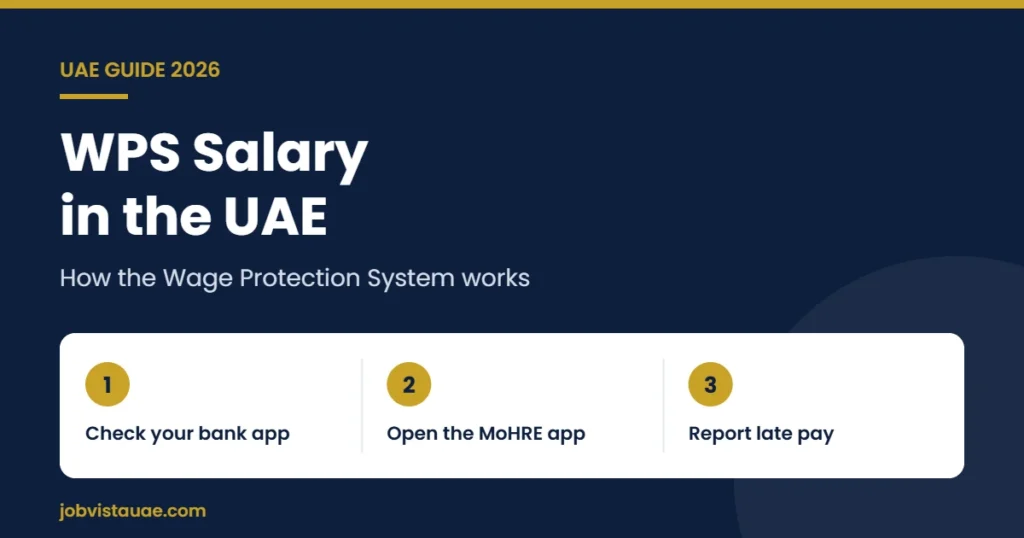
At present, there is no single official “WPS salary check” page for employees. Instead, use these steps:
- Check your bank or card app. Look for the credit and the payer name on the date your salary was due.
- Open the MoHRE app. Sign in with UAE PASS. The app’s salary service is also where you report delayed or missing pay.
- Ask HR. Also request your payslip or confirmation of the WPS transfer.
- Call MoHRE. If anything is unclear, call 600590000.
Checking a salary card balance
To check a WPS card balance, use the official app, website, ATM or helpline of the company that issued your card. You will find the issuer’s name on the card. However, avoid third-party “balance check” websites, because they may collect your card details.
Why WPS might not show your salary
Under Resolution 340, MoHRE does not monitor WPS payments for certain workers. According to u.ae, these include workers:
- whose wage complaint has gone to court
- with a work abandonment (absconding) report filed against them
- on unpaid leave, where the employer submitted documents to MoHRE
- whose freedom is restricted by order of an authority, with MoHRE notified
- who are seafarers on vessels, at the company’s request
- employed by foreign companies and paid outside the UAE, with their approval
- on mission work permits of three months or less
In addition, some employers are outside WPS monitoring, including banks and financial institutions and houses of worship. If none of these applies to you and your salary is missing, raise it quickly. Our guide to absconding in the UAE explains what a work abandonment report means.
What happens when salary is late
Under the current rules, MoHRE takes automatic action against employers who miss the 1st-of-month deadline:
| Days after the due date | Action against the employer |
|---|---|
| Day 2 | Notifications and alerts |
| Day 5 | New work permits suspended, with a warning |
| Day 11 | Fine and downgrade to the third category for repeat violations within six months |
| Day 16 | MoHRE registers a labour dispute automatically |
| Day 21 | Enforcement steps, which can include asset attachment, a travel ban on the person in charge or referral to the Public Prosecution |
In addition, an employer must pay at least 85% of the wages due on time, with any difference explained by lawful deductions. Still, do not wait for day 16 if your pay is late.
Your options as an employee
- First, ask HR in writing for a payment date.
- If that fails, file a complaint through the MoHRE app, website or 600590000. Our guide on how to file a MoHRE labour complaint walks you through it.
- If unpaid salary leads to losing your job, check whether you can claim ILOE unemployment insurance.
Common WPS myths
- “Salary is only late after 15 days.” That was the old rule. Now pay is due on the 1st, and alerts start on day 2.
- “Employers only need to pay 80%.” The threshold rose to 85% under Resolution 340.
- “Domestic workers are never covered.” In fact, MoHRE makes WPS mandatory for some domestic jobs.
Stay safe with your salary account
Never pay anyone to “activate” WPS or a salary card, and never share your card PIN or one-time codes. Likewise, ignore messages that ask you to “update” your WPS details through a link. Our guide to UAE job scams covers similar tricks.
Frequently asked questions
Is WPS mandatory in the UAE?
Yes, for private-sector employers registered with MoHRE, apart from the exclusions listed above. Free zones and domestic work have their own rules.
Can my employer pay me in cash?
A MoHRE-registered employer should pay you through WPS. If your employer pays you in cash, MoHRE cannot see the payment, which weakens your proof if a dispute arises.
Does WPS set a minimum salary?
No. Instead, WPS checks that you receive the salary in your contract. Our UAE salary guide explains pay levels and allowances.
Know where your salary stands
In short, check your bank or card app on payday, keep your payslips, and act quickly if salary is late. Because WPS records every payment, it gives you strong evidence if you ever need to complain.
Looking for an employer that pays on time? Browse the latest jobs in UAE or submit your CV.
This guide summarises u.ae, MoHRE and UAE media information as checked on 14 November 2026. App labels and procedures can change, so confirm current details with MoHRE on 600590000. It is general information, not legal advice.