Last updated:
Teacher jobs in Dubai attract applicants from all over the world, thanks to tax-free pay, international curricula and packages that often include housing and flights. However, the rules changed in 2025 and 2026. KHDA now applies stricter checks to every new teacher in Dubai’s private schools, and a new route lets some graduates start without experience.
To help, this guide explains who regulates teachers in Dubai and the UAE, the teaching licence, the qualifications schools ask for, when schools hire, how packages work and how to avoid fake teaching offers.
Want to see openings now? Browse current teaching vacancies on JobVista UAE.
Last checked: 14 November 2026. Sources: KHDA, the UAE Ministry of Education (MoE), MoHRE, ADEK announcements and UAE media.
Who regulates teachers in Dubai and the UAE?
There are two layers. First, you need the federal teaching licence. Second, your school needs approval from the regulator in its emirate.
| Body | What it does | Who applies |
|---|---|---|
| Ministry of Education (MoE) | Issues the UAE Teacher Licence after subject and professional exams | The teacher, through UAE PASS |
| KHDA (Dubai) | Approves each teacher in a Dubai private school with an Appointment Notice | The school |
| ADEK (Abu Dhabi) | Approves teachers through its School Staff Licensing Portal | The school |
| MoHRE | Issues the Private Teacher Work Permit for tutoring outside schools | The tutor |
The UAE teaching licence
The MoE licence has been mandatory for education professionals since 2021, according to Gulf News. In practice, it comes in three types: the Teacher Licence (subject, kindergarten, special education and vocational teachers), the School Leadership Licence, and the School Professionals Licence for roles such as classroom assistants, counsellors and librarians.
- Register. Teachers sign in to the licensing system with UAE PASS. Job seekers not yet at a school register through the MoE’s “Teach for UAE” route.
- Attest your degree. You need at least a bachelor’s degree, and your highest qualification must be attested or equated. Our UAE work visa process guide explains where attestation fits.
- Pass two exams. Next, you sit a subject exam and a professional exam on teaching practice.
- Receive your licence. Results usually arrive within a month, according to Gulf News.
Overall, you get three attempts at the exams. After a third failed attempt, you wait six months before trying again. Teachers who already hold an international licence can apply with their licence, licensing history, proof of experience and a criminal record clearance from their last country of residence. Since MoE fees have changed over time, check the current fee on the licensing system before you pay.
KHDA rules for Dubai private schools
On 10 September 2025, KHDA introduced new guidelines for appointing teachers. The main points are:
- Appointment Notice. Your school applies for one for every teacher, and you need a new one if you move school.
- Checks. Schools need at least two references and criminal record checks covering every country you have lived in, according to Khaleej Times.
- Induction. In addition, every teacher completes training on safeguarding, inclusion, UAE values and ethics, and signs a code of conduct.
- 90-day rule. If you leave mid-term, you must wait 90 days before teaching at another Dubai private school. However, leaving at the end of term after full notice avoids this.
- Exit survey. Departing teachers complete a KHDA exit survey before a new Appointment Notice can be issued.
Importantly, the rules also cover Arabic and Islamic Studies teachers. Meanwhile, teachers who stay at their current school have until September 2028 to meet the new qualification standards, or April 2029 at April-start schools.
A route for graduates without experience
According to Gulf Today (July 2026), new graduates with no teaching experience can now join Dubai private schools after at least six months of supervised training with an experienced teacher. In addition, a degree related to the subject can be accepted even if it is not an exact match. For example, an engineering graduate may teach maths or physics if they meet the training requirements.
Qualifications schools ask for
- a bachelor’s degree related to your subject, attested (nursery staff working with children under 36 months are an exception to the degree rule)
- the MoE teaching licence, or the documents to obtain it
- clean criminal record checks and a medical fitness result
- references, including one from your most recent employer
On top of that, premium British, IB and American schools usually prefer a recognised teaching qualification such as a PGCE, QTS or a state licence, plus about two years of experience. That is employer preference, not law. Similarly, ADEK lists an accredited teaching licence or recognised education diploma for Abu Dhabi.
When Dubai schools hire
Most UAE schools start the year in late August or September, although many Indian-curriculum schools start in April. According to Gulf News and Khaleej Times (June 2026), large groups such as Taaleem start recruiting before the current year ends, and many had filled most posts by early summer. The typical pattern for an August start looks like this:
| Period | What usually happens |
|---|---|
| September to January | Premium international schools advertise, attend fairs and interview overseas candidates |
| February to May | Second wave of hiring, including candidates already in the UAE |
| June to August | Late and replacement vacancies |
Across the sector, schools in 2026 reported the strongest demand for STEM, computer science and AI, early years, maths, science and English teachers.
Teacher salary and package in Dubai
Pay varies widely by curriculum and school tier, and no official salary data exists for private-school teachers. As one reference point, recruiter Teacher Horizons (August 2026) reported average base salaries of about AED 127,000 a year for entry-level international teachers and AED 177,000 for experienced teachers, at the schools it works with. By contrast, Indian and Asian curriculum schools generally pay considerably less.
In addition to the salary, a typical international package includes:
- housing, either provided or as an allowance
- an annual return flight
- medical insurance
- tuition discounts for your children at some schools
- end-of-service gratuity under UAE law
Before you accept, compare the basic salary, housing and notice terms in writing. Our job offer letter guide shows what to check, and our UAE salary guide explains how allowances work.
Types of teaching roles
- Classroom and subject teachers: need the MoE Teacher Licence and, in Dubai, a KHDA Appointment Notice.
- Teaching assistants: fall under the MoE School Professionals Licence.
- Early years and nursery staff: for children under 36 months, the bachelor’s minimum does not apply.
- SEN and inclusion teachers: covered by the Teacher Licence’s special education category.
- Private tutors: need the free MoHRE Private Teacher Work Permit, valid for two years. See our part-time work permit guide for other part-time options.
How to apply for teacher jobs in Dubai
- Prepare your documents. First, attest your degree and gather references and police clearances.
- Update your CV. List your curriculum, key stages, results and safeguarding training. Our UAE CV format guide and cover letter guide help.
- Apply early. Then use school group career pages, recruitment fairs and known education job boards.
- Prepare for panel interviews. Expect safeguarding questions and, often, a video interview first. Read our online interview tips.
- Check the offer. Finally, confirm the package, start date and notice period before you sign.
Avoid fake teaching offers
In August 2025, several UAE schools, including Woodlem, Shining Star International School and BITS Pilani Dubai, warned about fake job ads using their names to collect personal data or ask for payments. Therefore, protect yourself:
- check that the school exists in the KHDA or ADEK school directory
- apply through the school’s own careers page or a known job board
- never pay an agent for an offer, a visa or “licence processing”, because the school applies for KHDA approval itself
- be wary of any offer made without a proper interview
For more warning signs, read our guide to UAE job scams and how to verify an employer.
Frequently asked questions
Can I teach in Dubai without a teaching qualification?
You need at least a relevant bachelor’s degree. Under KHDA’s current guide, new graduates can start after six months of supervised training, although many premium schools still prefer a PGCE, QTS or equivalent.
Do I need the UAE teaching licence before I arrive?
In general, requirements depend on the school and emirate. Ask your school which licence steps it needs before your start date, and keep your attested documents ready.
What is the KHDA 90-day rule?
If you leave a Dubai private school mid-term, you must wait 90 days before teaching at another one. Leaving at the end of term after serving full notice avoids the wait.
Start your teaching career in Dubai
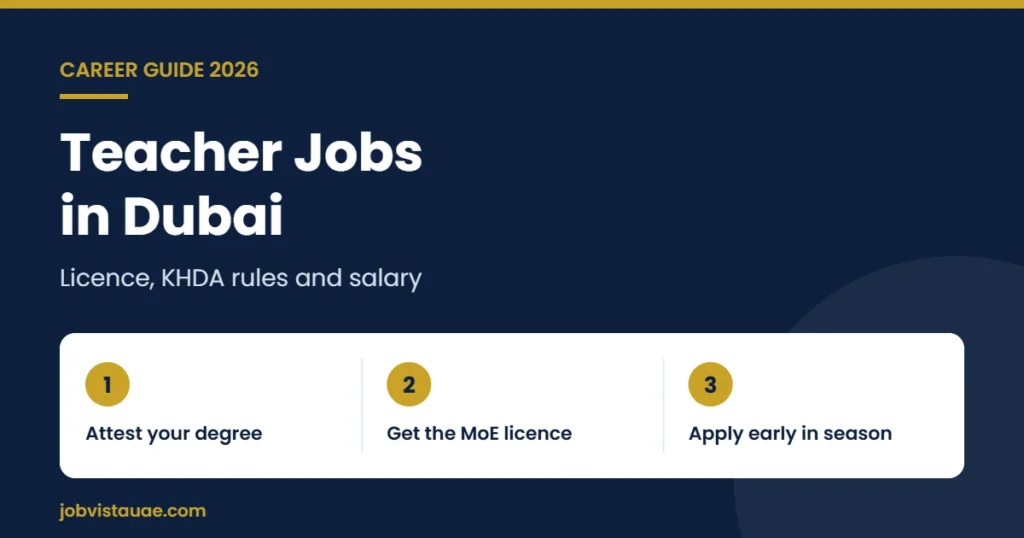
In short, attest your degree, start the MoE licence process, apply early in the hiring season and check every offer carefully. Above all, apply only through genuine schools.
Ready to apply? Browse the latest jobs in UAE or submit your CV.
This guide summarises KHDA, MoE, MoHRE and ADEK information and UAE media reports as checked on 14 November 2026. Salary figures are recruiter estimates, not official data. Licensing rules can change, so confirm current requirements with your school and the regulator.