Ask around in the UAE and you will hear a confident rule: if your employer fires you, they owe you three months’ salary. It is one of the most widely believed things about UAE employment, and thousands of people search for it every month.
It is also wrong — or rather, it is a real rule that almost never applies the way people think it does.
Termination of employment in UAE follows Federal Decree-Law No. 33 of 2021. This guide explains what your employer may lawfully do, what you are genuinely owed when they end your contract, and where that three-month figure actually comes from. It also covers the parts people rarely think about until they need them: visa grace periods, labour bans and unemployment insurance.
Who these rules apply to
Everything below covers private-sector employees on the UAE mainland under contracts registered with the Ministry of Human Resources and Emiratisation (MoHRE).
DIFC and ADGM run separate employment regimes with their own courts and their own compensation rules, so do not apply these figures there. Government employees follow civil service rules instead.
As always, the English versions of UAE legislation online are translations. The Arabic original governs wherever the two differ.
Does being fired entitle you to three months’ salary?
No. Not as a general rule.
There is a three-month figure in the law, and that is why the belief persists. However, it works nothing like a severance entitlement.
What Article 47 actually says
Article 47 covers what the current law calls unlawful termination. It treats a dismissal as unlawful in one narrow situation: where your employer terminated you because you filed a serious complaint with MoHRE, or filed a lawsuit against them whose validity is proven.
If a court finds that link proven, it then sets fair compensation, weighing the type of work, the damage you suffered and your length of service. That award cannot exceed three months of your wage, calculated on your last wage.
Read that carefully, because two things follow.
- Three months is a ceiling, not a payment. A judge decides the actual figure, and it can be far less.
- The trigger is retaliation, not unfairness. Redundancy, restructuring, poor performance, contract expiry or dismissal for misconduct do not engage Article 47 at all — however unfair the situation feels.
UAE law firms report that courts are declining to award anything outside those two retaliation scenarios. So for most dismissed employees, the realistic Article 47 outcome is nothing — which is very different from being owed nothing overall.
It is worth knowing that the older Federal Law No. 8 of 1980 had a broader arbitrary-dismissal standard. Articles still citing that law’s provisions describe a test that no longer exists, which is a large part of why the confusion survives.
The three payments people confuse
Most of the myth comes from blending three separate entitlements into one. They have different triggers, different bases and different amounts — and importantly, they stack.
| Payment | What it compensates | When you get it |
|---|---|---|
| Pay in lieu of notice | Notice time you did not work | Automatically, if notice was not given or worked. No fault needed. |
| End-of-service gratuity | Years you already served | Automatically, after one year of service, whatever ended the contract. |
| Article 47 compensation | Being fired in retaliation | Only if a court finds the retaliation link proven. Capped at three months. |
Winning one does not cancel the others. An employee who succeeds under Article 47 receives that compensation on top of gratuity and notice pay, not instead of them.
When can your employer terminate you?
Termination with notice
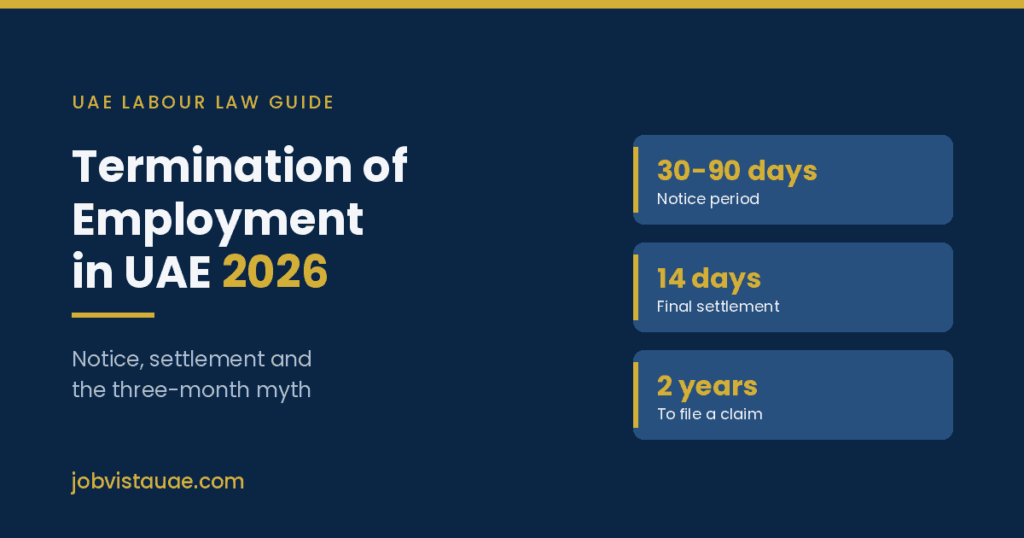
Article 43 lets either party end the contract for any legitimate reason, provided they notify the other side in writing. The notice period is whatever your contract sets, within a floor of 30 days and a ceiling of 90 days.
Normally you work during that period. Where a party does not honour the notice, though, Article 43 makes them pay a notice period allowance equal to the wage for the full notice period, or whatever remains of it.
One detail deserves emphasis. That allowance falls due even where the missing notice caused no damage. You do not need to prove loss to claim it.
Dismissal without notice
Article 44 lets an employer dismiss immediately, but only on ten specific grounds. They include using forged documents or a false identity, causing serious deliberate loss, breaching posted written safety rules, repeatedly failing basic duties after a written warning, disclosing trade secrets, being under the influence of alcohol or drugs at work, assaulting the employer or a colleague, and working elsewhere without following the proper procedure.
Extended unexplained absence also qualifies — more than seven consecutive days, or more than twenty non-consecutive days in a year.
Procedure matters here as much as grounds. Article 44 requires a written investigation first, followed by a written, justified dismissal decision handed to you. An employer who skips those steps has not simply made a paperwork error; it weakens their position considerably.
Crucially, dismissal under Article 44 preserves your right to end-of-service gratuity. The old law wiped gratuity out in these cases. The 2021 law reversed that deliberately, and our UAE gratuity guide explains what survives and what an employer may lawfully deduct.
Termination during probation
Probation runs to a maximum of six months. During it, an employer must give you 14 days’ written notice to terminate.
Your own obligations differ depending on what you do next. Leaving the UAE requires 14 days’ notice, while moving to another UAE employer requires one month. Our guide to the probation period in UAE covers the detail, including the three-month return rule.
Is redundancy a thing in UAE law?
Not as a defined legal category, no. UAE labour law contains no equivalent of a statutory redundancy process or redundancy pay.
Instead, an employer restructuring or downsizing simply terminates under Article 43 with proper notice, and owes exactly what any other notice-based termination owes. There is no reduced-obligation route for business reasons, and equally no enhanced payment.
So if you are told you are “being made redundant,” treat it as an ordinary Article 43 termination and check that the notice and settlement match.
What you are owed when your employer terminates you
Regardless of why the contract ended, a normal final settlement includes:
- Outstanding wages up to your last working day.
- Pay in lieu of notice, where you did not work your notice period.
- End-of-service gratuity, after one year of service — 21 days’ basic wage a year for your first five years, then 30 days a year, capped at two years’ wage.
- Accrued but untaken annual leave, calculated on basic salary.
- Repatriation to your point of hire, which Article 13 places on the employer.
Note that gratuity and leave encashment both use your basic salary, not your total package. Article 47 compensation, by contrast, works from your last wage, which sources describe as including regular allowances. Those different bases catch people out, so check which one each line of your settlement uses.
Our guides to annual leave in UAE and the UAE salary guide explain the basic-versus-allowances split in more detail.
The 14-day deadline
Article 53 gives your employer 14 days from the end of your contract to settle everything above. Miss that window and you have grounds for a MoHRE complaint.
Does termination trigger a labour ban?
This question causes more anxiety than almost any other, and the answer is more reassuring than most people expect.
First, separate two things that get constantly conflated. A MoHRE work-permit ban restricts your ability to get a new work permit. An immigration entry ban restricts entering the country. They are different mechanisms, issued by different authorities, for different reasons.
The one-year work-permit ban people worry about attaches to unauthorised abandonment of work before the contract ends, not to ordinary employer-initiated termination. In other words, being terminated by your employer is not itself a reason for a ban.
Several exemption categories also exist, including family-sponsored residents and highly skilled professionals. Because the specific criteria change and depend on your circumstances, confirm your own position with MoHRE rather than relying on any general article.
How long can you stay in the UAE?
Once your employer cancels your residence visa, a grace period begins. The length depends on your visa category rather than on why the job ended.
| Visa category | Grace period |
|---|---|
| Golden, Green and Blue visa holders; some family members; students completing studies | 180 days |
| Skilled workers in levels 1 to 3; property owners | 90 days |
| Guarantor or host-sponsored residents | 60 days |
| All other categories | 30 days |
Overstaying past your grace period attracts a daily fine. Since these periods and fines change, verify yours with the Federal Authority for Identity and Citizenship before you plan around a date.
Unemployment insurance after termination
The UAE runs a mandatory unemployment insurance scheme, usually called ILOE, and many employees forget they are covered until it is too late to claim.
Subscribers fall into two premium categories based on basic salary. The scheme pays 60% of your average basic salary over your last six months, subject to a monthly cap, for a maximum of three months per claim.
Two conditions matter most. You need a minimum subscription period before you can claim, and you must submit the claim within a short window after your employment ends — reported as 30 days. Miss it and the entitlement lapses.
Several situations disqualify a claim, including resignation, dismissal for disciplinary reasons and an absconding complaint. Check the current rates, caps and deadlines on the official ILOE channels, because the scheme is recent and figures do move.
How to challenge a termination
Start with MoHRE. Filing a labour complaint costs nothing, and you can do it through the MoHRE app, the online portal or by phone.
MoHRE then attempts an amicable settlement. Where that fails, the route depends on the value of your claim: MoHRE can decide claims up to AED 50,000 itself, while larger claims go to court with MoHRE’s file.
You have two years to claim, not one
This is the single most commonly misstated figure in UAE employment content.
The current limitation period is two years from the date your employment relationship ended, under Article 54(9) as amended by Federal Decree-Law No. 9 of 2024.
Before that amendment it was one year, running from a different starting point. As a result, a great deal of content still says one year, and at the time of writing some official summary pages had not caught up either. Because a limitation period decides whether you can claim at all, confirm your own deadline with MoHRE directly.
Practical traps to avoid
- Signing clearance before payment arrives. Once you sign to say you have received everything, recovering a shortfall gets considerably harder. Wait for the money.
- Walking away without written notice. Unauthorised absence is exactly what triggers the work-permit ban discussed above. If there is a dispute, file a complaint rather than simply stopping work.
- Letting your passport go. An employer holding your passport is unlawful under Article 13. Your passport is yours.
- Paying to keep or get a job. Recruitment costs sit with the employer. Anyone asking you to pay for a job, a visa or a placement should be verified before you go further.
- Missing the ILOE window. A short claim deadline runs from your termination date, not from when you start job hunting.
Five claims about UAE termination that are out of date
- “Anyone fired gets three months’ salary.” Article 47 sets a ceiling, and only for proven retaliation against a complaint or lawsuit.
- “Dismissal for cause destroys your gratuity.” Article 44 expressly preserves it.
- “You have one year to bring a claim.” Two years since the 2024 amendment, running from the end of employment.
- “Limited and unlimited contracts have different termination rules.” That distinction no longer exists on mainland contracts.
- “Any termination means an automatic labour ban.” The ban attaches to unauthorised abandonment, not to being terminated.
A quick test helps here. The current law runs to 74 articles, so any source citing article numbers in the 120s is quoting the repealed 1980 law.
Frequently asked questions
Do I get three months’ salary if my company terminates me in the UAE?
Not automatically. Article 47 allows a court to award up to three months’ wage, but only where you prove your employer terminated you because you filed a serious MoHRE complaint or a valid lawsuit against them. Ordinary terminations do not trigger it. You are still owed notice pay, gratuity and accrued leave.
What is the notice period for termination in the UAE?
Your contract sets it, within a minimum of 30 days and a maximum of 90 days under Article 43. During probation, an employer must give 14 days’ notice instead.
Can my employer terminate me without notice?
Only on one of the ten grounds in Article 44, and only after a written investigation followed by a written, justified decision. Even then, you keep your end-of-service gratuity.
Do I get gratuity if my employer terminates me?
Yes, provided you completed at least one year of continuous service. Under the current law, gratuity does not depend on who ended the contract or why.
How long do I have to leave the UAE after termination?
It depends on your visa category, with grace periods ranging from 30 to 180 days after cancellation. Confirm yours with the Federal Authority for Identity and Citizenship, since these periods change.
Where to check the law yourself
Prefer primary sources to summaries, this one included. Start with the Ministry of Human Resources and Emiratisation, the official UAE Government portal, and the legislation portal’s record of Federal Decree-Law No. 33 of 2021.
If you have just been terminated
Work through four things in order. First, get the termination in writing and keep it. Second, calculate what your settlement should contain rather than accepting the first figure offered. Third, note your visa grace period and your ILOE claim deadline, because both run whether or not you act. Fourth, file with MoHRE if the settlement falls short.
Above all, resist the temptation to sign a clearance document to speed things up. That signature is usually the hardest thing to undo.
If you are planning your next move instead, our guide to resignation in UAE covers leaving on your own terms. When you are ready, browse the latest UAE job vacancies or explore more UAE career guides.
This guide provides general information about UAE employment law and is not legal advice. We checked every figure and provision in September 2026, and the law changes. For a decision affecting your own contract, settlement or visa status, consult MoHRE or a qualified UAE employment lawyer.