Annual leave in UAE looks simple on paper: work a full year, take 30 days off. In practice, though, the rules about how your employer pays those days, who picks the dates, and what happens to days you never use are where nearly every dispute begins.
One gap costs employees more money than all the others combined. Your employer uses one salary base for leave you actually take, and a lower one for leave you cash in. Most people only notice when they read their final settlement.
This guide walks through what Federal Decree-Law No. 33 of 2021 and its Executive Regulation actually say. It also flags several widely repeated claims that the current law does not support, so you know which advice to ignore.
Who these rules apply to
Everything below covers private-sector employees working on the UAE mainland under contracts registered with the Ministry of Human Resources and Emiratisation (MoHRE).
Some free zones run their own employment regimes instead. DIFC and ADGM are the best-known examples, and their leave rules differ from the federal position. Federal and local government staff follow civil service rules. So if you fall into one of those groups, check your own framework before relying on the figures here.
One further caveat is worth knowing. The English versions of UAE labour legislation circulating online are translations, and the Arabic original governs wherever the two disagree.
How many days of annual leave you get
After one full year of service
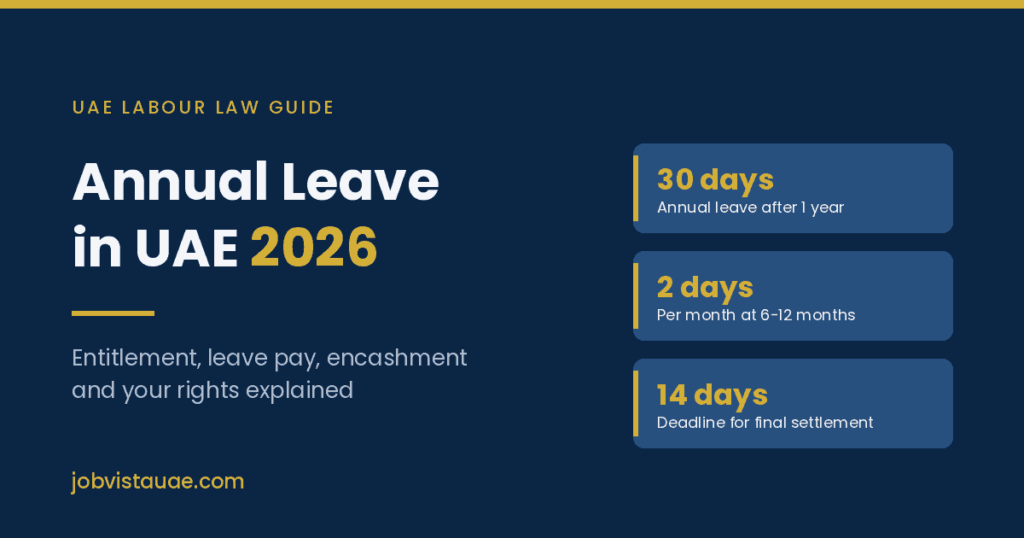
Once you complete one year of continuous service, Article 29(1)(a) entitles you to 30 days of paid annual leave per year. That figure is the headline number almost everyone knows.
Between six and twelve months of service
If you have worked more than six months but less than a year, Article 29(1)(b) gives you two days of leave for each month of service.
Under six months of service
Article 29 sets no annual leave entitlement for service shorter than six months. Some employers grant days anyway as a matter of policy, so read your contract. Just do not assume a statutory right exists at that stage, because the text does not create one.
| Length of service | Annual leave entitlement | Source |
|---|---|---|
| One year or more | 30 days per year | Article 29(1)(a) |
| Six to twelve months | Two days per month | Article 29(1)(b) |
| Under six months | Not specified in Article 29 | — |
If you are still serving your probation period, the interaction between leave, notice and early resignation works differently. Our guide to the probation period in UAE covers those first months in detail.
The pay difference most employees miss
Leave you take earns your full wage
Article 29(6) is clear on this point. When you actually take your annual leave, your employer pays you your full wage for those days. That means basic salary plus the allowances that form part of your wage.
Leave you cash in earns basic salary only
Article 29(9), read together with Article 19(2) of the Executive Regulation, works the other way. Where you cash leave out instead of taking it as time off, the calculation uses your basic salary alone. Your allowances drop out of the sum entirely.
Because UAE packages often split salary heavily toward housing and transport allowances, that single distinction can be worth thousands of dirhams.
What the gap looks like in numbers
Take a hypothetical employee on AED 12,000 a month, split as AED 7,000 basic and AED 5,000 allowances. Now compare ten days taken against ten days cashed out.
| Ten days taken as leave | Ten days paid in cash | |
|---|---|---|
| Salary base used | Full wage — AED 12,000 | Basic only — AED 7,000 |
| Daily rate (÷30 convention) | AED 400.00 | AED 233.33 |
| Total for ten days | AED 4,000.00 | AED 2,333.33 |
In this example the cashed-out version pays roughly 58% of what the same ten days would be worth if you took them.
Two warnings belong with that table, though. First, the salary split above is an illustration only, and your own basic-to-allowance ratio will change the result significantly. Second, dividing monthly pay by 30 to reach a daily rate is common market practice rather than a formula that Article 29 sets out. Employers do use other divisors, so ask your HR team which one your contract applies.
For a sense of how basic-to-allowance splits differ across industries, see our UAE salary guide.
Public holidays that fall inside your leave
Article 29(7) addresses this directly. Public holidays and sick leave falling within a period of annual leave count as part of that annual leave, unless your contract or your employer’s own regulations are more generous.
In other words, a public holiday inside your leave does not automatically buy you an extra day. Cabinet Resolution No. 27 of 2024 confirms that your employer owes no substitute day in that situation.
The practical takeaway is easy to miss. Booking leave around a long public holiday weekend can quietly consume days of your entitlement, so check the holiday calendar before you submit the request.
Carrying annual leave into the next year
Article 19(1) of the Executive Regulation permits carry-forward, but it caps the amount. You may carry over no more than half your annual leave entitlement into the following year, which works out at up to 15 days on a 30-day entitlement, by agreement with your employer.
Alternatively, you and your employer may agree that your employer pays the balance in cash. Sources conflict on which salary base applies to a cash payment you take while you still work there, so ask your employer to confirm the basis in writing before you agree to anything.
What the law does not say is that days above the cap simply vanish. Article 29(8) in fact points in the opposite direction, because your employer cannot prevent you from using leave that has accrued for more than two years. So if a company tells you your untaken days have expired, ask them to show you the clause they are relying on.
Who chooses your leave dates
Your employer does, within limits. Article 29(4) allows the employer to set annual leave dates according to work requirements, or to rotate them among staff so the business keeps running.
However, the same article attaches a condition that employees frequently overlook. The employer must notify you of your leave dates at least one month in advance.
So a manager cannot tell you on Thursday that your annual leave starts on Sunday. If that happens to you, the one-month notice requirement is the provision to point at.
Annual leave during your notice period
Article 35 covers the overlap. Your notice period does not run while you are on annual leave, unless you and your employer agree otherwise.
That makes sense once you consider what each period is for. Notice exists so both sides can plan a proper handover, while leave exists so you can rest. Stacking one on top of the other defeats both purposes.
Because employer practice varies widely here, confirm any arrangement in writing before your last month begins.
Unused leave when you leave the company
When your employment ends, your employer pays out any annual leave you accrued but never took. As explained above, Article 29(9) sets the basis for that payment as your basic salary.
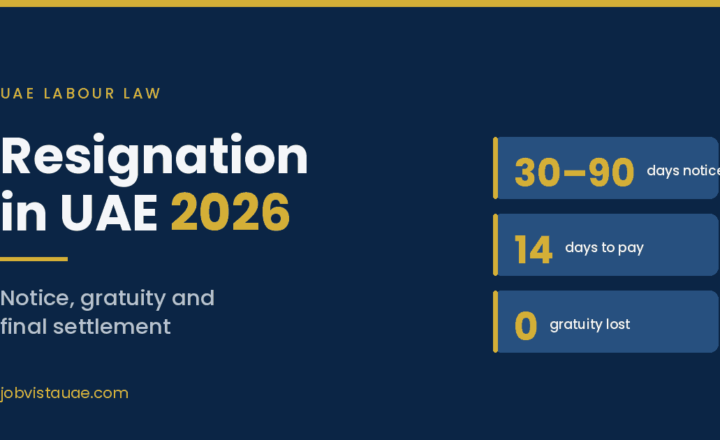
Article 53 then sets the deadline. Your employer must settle your end-of-service entitlements within 14 days of the contract ending.
One frequent confusion deserves clearing up. People often mention a “two-year cap” in this context, but that cap comes from Article 51(6) and applies to gratuity, which cannot exceed two years’ wage. It has nothing to do with leave encashment. Our UAE gratuity calculation guide explains how to work that figure out.
Does your employer owe you a flight home?
This question attracts more inaccurate advice than any other part of the topic, so it is worth separating two very different things.
The current law, at Article 13(12), requires your employer to cover the cost of your repatriation — returning you to your point of hire once employment ends. That is an end-of-service obligation.
An annual holiday ticket is a separate matter. No provision of Federal Decree-Law No. 33 of 2021 grants one. Where employees do receive a yearly ticket, it comes from their employment contract or company policy rather than from the Labour Law itself.
You will still find articles citing “Article 131” as the source of an annual ticket entitlement. That article belonged to Federal Law No. 8 of 1980, which the 2021 law repealed. Treat any source still quoting it as out of date.
Since the annual ticket is contractual, it belongs in your offer letter in writing. Our guide on what to check in a UAE job offer letter walks through the clauses that matter most.
Unpaid leave and your gratuity
Unpaid leave carries a consequence that few employers explain at the time you request it. Article 33 excludes periods of unpaid leave from your length of service.
The effect is financial rather than immediate. Because gratuity rests on your years of service, a long stretch of unpaid leave shortens the period that counts toward it.
Five claims the law does not support
Plenty of UAE career sites repeat the following statements. None of them holds up against the current text.
- “You accrue 2.5 days a month in your first year.” Article 29(1)(b) sets two days per month between six and twelve months of service. The 2.5 figure appears nowhere in the law.
- “Divide your salary by 30 — that is the legal daily rate.” It is a widespread convention, not a statutory formula. Article 29 prescribes no divisor at all.
- “Leave keeps accruing while you are on sick or unpaid leave.” The law does not state this, and Article 33 actually excludes unpaid leave from your period of service. So do not assume either way without checking your contract.
- “Article 131 gives you an annual flight ticket.” The 2021 law repealed that provision, as explained above.
- “Anything above the carry-forward cap is automatically forfeited.” The Executive Regulation caps what you may carry over, yet it does not say you lose the excess.
Frequently asked questions
How many days is annual leave in UAE?
Thirty days a year once you have completed a full year of service, under Article 29(1)(a). Between six and twelve months of service, you earn two days per month instead.
Is annual leave paid on basic salary or full salary?
It depends on whether you take the days or cash them in. Your employer pays leave you actually take at your full wage, under Article 29(6). Leave you cash out draws on basic salary only, under Article 29(9) and Article 19(2) of the Executive Regulation.
Can my employer refuse my annual leave request?
Your employer may set or rotate leave dates according to work requirements under Article 29(4), provided it gives you at least one month’s notice of those dates. Separately, Article 29(8) says your employer cannot prevent you from using leave that has accrued for more than two years.
Do weekends count as part of my annual leave?
Article 29(7) deals with public holidays and sick leave falling inside annual leave, but it does not address weekly rest days. Practice therefore comes down to your contract and company policy, so check both rather than assuming.
How long does my employer have to pay my leave balance after I resign?
Article 53 gives your employer 14 days from the end of your contract to settle your end-of-service entitlements, including your accrued leave balance.
Where to check the law yourself
Always prefer primary sources over summaries, including this one. Start with the Ministry of Human Resources and Emiratisation and the official UAE Government portal, both of which publish the Labour Law and its Executive Regulation.
If you cannot resolve a disagreement with your employer internally, MoHRE handles labour complaints for mainland private-sector employees and can explain the process that applies to your case.
Before you book your next leave
Annual leave is one of the few benefits where knowing the clause number genuinely changes the money in your account. The 30 days are the easy part. The pay base, the one-month notice rule, the carry-forward cap and the ticket question are where the real value sits.
Two habits will protect you. First, read the leave clauses in your contract before you sign it, not when you resign. Second, put every leave agreement in writing, particularly anything involving cash in lieu of days off.
Looking for a role with a package worth reading closely? Browse the latest UAE job vacancies on JobVista UAE, or explore more UAE career guides to prepare for your next move.
This guide provides general information about UAE employment law and is not legal advice. For a decision that affects your own contract or settlement, consult MoHRE or a qualified UAE employment lawyer.