Last updated:
Applying for a personal loan, car finance or a credit card in the UAE? Many banks will ask for a salary transfer letter before they approve you. It sounds similar to a salary certificate, but it does a different job, and it asks more of your employer.
This guide explains what a salary transfer letter is, what it usually includes, how to request one, and what to think about before you sign up for a salary-transfer product.
What is a salary transfer letter?
A salary transfer letter is a letter from your employer to a bank, confirming that the company will pay your salary into an account at that bank. In other words, it commits your employer to where your pay goes, not just to what you earn.
Banks ask for it because a salary paid directly into their own account gives them more security when they lend. For example, many personal loans and some credit cards are offered as “salary transfer” products, often with different terms from non-salary-transfer options.
Salary transfer letter vs salary certificate
| Salary certificate | Salary transfer letter | |
|---|---|---|
| Main purpose | Confirms your employment and salary | Confirms your employer will pay your salary into a specific bank |
| Addressed to | Any organisation, or “To Whom It May Concern” | The named bank |
| Commitment by employer | Information only | An undertaking about where your pay goes |
| Typical use | Family visas, tenancy, embassy visas | Salary-transfer loans and credit cards |
If you only need proof of income, a salary certificate is usually enough. Our guide to the salary certificate in UAE covers it in detail.
What a salary transfer letter usually includes
Each bank has its own format; however, many provide a template for the employer to complete. Typically, the letter includes:
- company letterhead, date, authorised signature and company stamp
- your name, passport or Emirates ID number and job title
- your date of joining and monthly salary, often split into basic pay and allowances
- the bank account number or IBAN your salary will be paid into
- an undertaking to keep paying your salary into that account
- in many templates, an undertaking to inform the bank if your employment ends, and sometimes to pay your end-of-service dues into the same account
Because some of these lines commit the employer, HR may take longer to approve a salary transfer letter than a salary certificate. In addition, some companies limit which banks they will issue one for.
How to request a salary transfer letter
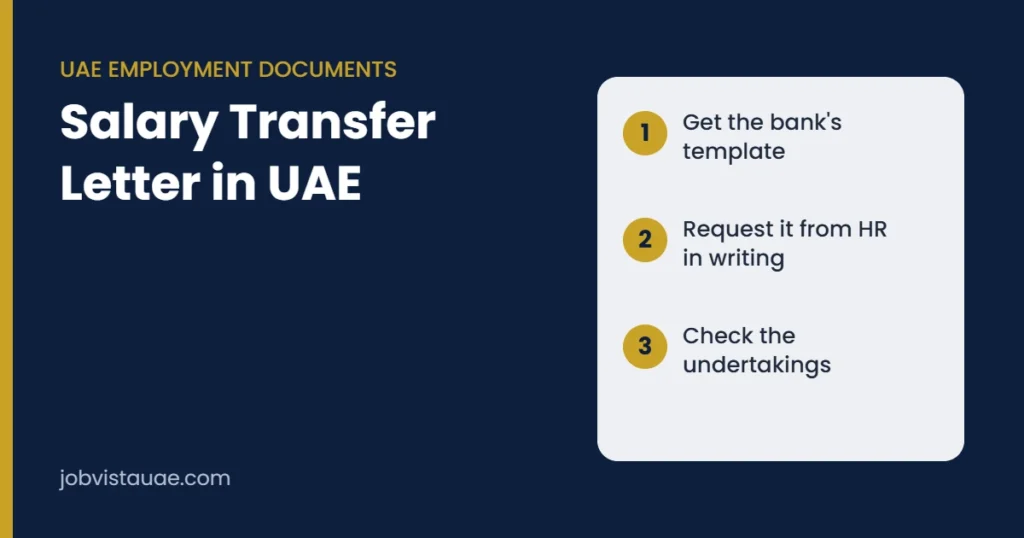
- Get the bank’s template first. Ask the bank for its exact format, so HR does not have to redo the letter.
- Check your employer’s policy. Then ask HR whether the company issues salary transfer letters and for which banks.
- Submit a written request. Include the bank’s name, the template and the account details.
- Review the letter before you submit it. Check your name, salary figures and the IBAN carefully.
- Keep a copy. Also note any undertakings, because they affect what happens if you change jobs.
Before you sign up for a salary-transfer loan
A salary-transfer product links your loan to your job. Therefore, think about these points first:
- Changing jobs. Your new employer may need to issue a new salary transfer letter to the same bank. Check what the loan terms say if your salary stops arriving.
- End-of-service dues. If the letter commits your employer to pay your final settlement into the bank, the bank may use it to recover what you owe under your agreement. Read the loan terms carefully.
- Compare offers. Finally, banks set their own rates, fees and conditions for salary-transfer and non-salary-transfer products.
This guide gives general information, not financial advice, so read the bank’s key facts statement and terms, and ask the bank to explain anything you do not understand.
Salary transfers and the Wage Protection System
Mainland private-sector employers pay salaries through the Wage Protection System (WPS), so your salary already arrives through an official channel. A salary transfer letter simply tells your employer which bank account to use. If your salary is late or missing, read our guide to the UAE salary payment rules.
Avoid salary letter fraud
In practice, only your real employer can issue a salary transfer letter. If anyone offers to produce one from a company you do not work for, or to “boost” your salary on paper, refuse. Above all, submitting a false salary document to a bank can lead to serious legal consequences.
Frequently asked questions
Is a salary transfer letter the same as a salary certificate?
No. A salary certificate confirms your employment and salary. By contrast, a salary transfer letter confirms that your employer will pay your salary into a specific bank account.
Can my employer refuse to issue a salary transfer letter?
Some employers have policies on which banks they will issue letters for, because the letter contains undertakings. If yours refuses, ask the bank whether it offers a product that does not need salary transfer.
Do I need a salary transfer letter for a credit card?
It depends on the bank and the card. Some cards require salary transfer, while others only need proof of income, such as a salary certificate and bank statements.
Ask for the right letter
In short, use a salary certificate when you need proof of income, and a salary transfer letter only when the bank’s product requires it. Get the bank’s template, request the letter in writing, and understand the undertakings before you sign a loan.
Looking for a role with a stronger package? Browse the latest jobs in UAE and read our UAE salary guide.