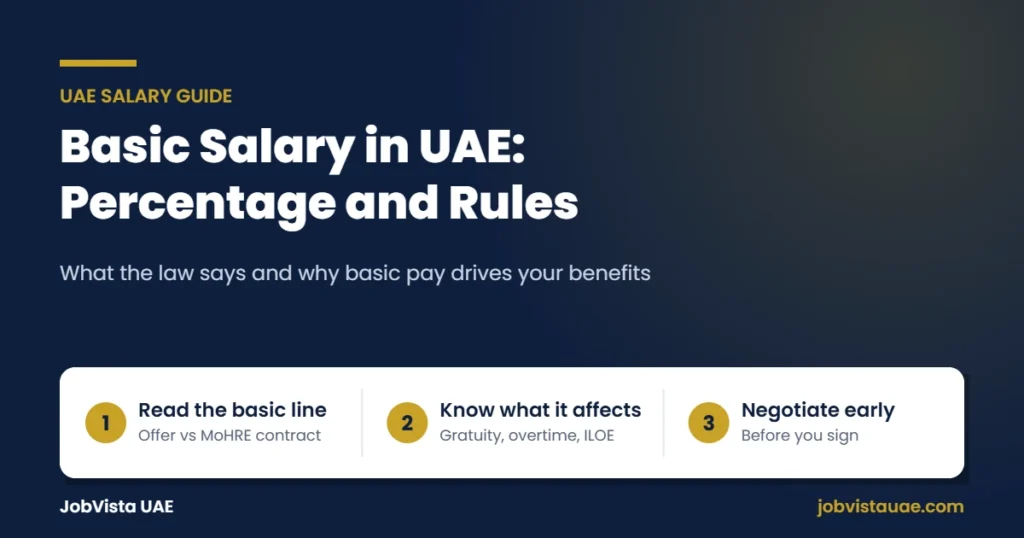
Your basic salary in the UAE is often only part of your monthly pay, yet it decides how much gratuity, overtime and leave encashment you receive. Many offers split pay into basic salary, housing and transport, and some keep the basic line very low. So before you sign, you need to know what the law says about basic salary and what it affects.
This guide explains how UAE law defines basic salary, whether any minimum percentage applies, which payments use basic pay and which use your full wage, and what to check in an offer.
Last checked: 22 November 2026. Sources: Federal Decree-Law No. 33 of 2021 (MoHRE English text on u.ae), u.ae, ILOE and UAE media. This guide covers the mainland private sector.
What is basic salary in the UAE?
Article 1 of the UAE Labour Law uses two separate terms:
- Basic wage: the wage stated in your employment contract, without any allowances or benefits in kind.
- Wage: the basic wage plus cash allowances and benefits in kind, such as housing and transport.
In other words, when the law says “wage” it usually means your total package. When it says “basic wage”, it means the basic line only. That small difference changes many of your entitlements.
Is there a basic salary percentage in UAE law?
No. Neither the mainland Labour Law nor any MoHRE rule we found sets a minimum share of basic salary in total pay. Article 27 only allows the Cabinet to set minimum wages.
However, you may read two other figures online, and both need context:
- “At least 60%”. This is a financial adviser’s recommendation in The National, not a legal rule.
- “50% basic”. This rule exists only under the DIFC Employment Law, which applies inside the DIFC free zone.
In practice, payroll providers such as TASC Outsourcing describe basic pay at around 50–60% of fixed pay. Even so, offers can go much lower, so always read the breakdown.
The Emirati minimum wage
Since 1 January 2026, MoHRE has set a minimum wage of AED 6,000 a month for Emiratis in the private sector, and existing salaries had to rise by 30 June 2026. The announcements we checked do not say whether the figure means basic or total pay. Our Nafis programme guide covers the wider rules.
What basic salary affects
The table below shows which payments the law links to your basic wage and which use your full wage.
| Payment | Calculated on | Legal basis |
|---|---|---|
| End-of-service gratuity | Basic wage (21 or 30 days a year) | Article 51 |
| Overtime | Basic wage plus at least 25%, or 50% from 10 pm to 4 am | Article 19 |
| Work on a public holiday | Basic wage plus at least 50%, or a day off | Article 28 |
| Unused leave paid out when you leave | Basic wage | Article 29 |
| Annual leave you actually take | Full wage | Article 29 |
| Sick and maternity pay | Full or half “wage” | Articles 30 and 31 |
| ILOE unemployment insurance | Basic salary (category and payout) | ILOE rules |
Gratuity is the biggest example. For instance, if your basic salary is AED 3,000 of a AED 6,000 package, your gratuity is calculated on AED 3,000, not AED 6,000. Our UAE gratuity guide shows the full formula, and the gratuity calculator does the maths for you.
Similarly, leave you take is paid on your full wage, while leave you cash in at the end is paid on basic. Our annual leave guide explains that difference, and our working hours guide covers overtime.
ILOE unemployment insurance
According to ILOE, your category depends on whether your basic salary is up to AED 16,000 or above it. If you claim, the payout is 60% of your average basic salary over the last six months, within the monthly cap for your category. See our ILOE guide for details.
Family visa and bank loans
By contrast, the family visa rule on u.ae (AED 4,000, or AED 3,000 plus accommodation) does not say whether it means basic or gross pay. Likewise, banks set their own rules for loans and cards. So ask GDRFA, ICP or your bank directly. Our family visa guide covers the rest.
Can your employer reduce your basic salary?
Not on its own. Under Article 24, moving you to a different pay category needs your written consent. According to The National, a change to basic salary should also be agreed in writing and recorded with MoHRE.
In addition, Article 25 limits deductions from your wage, with an overall cap of 50%. If your employer cuts your basic pay without consent, keep your contract and payslips, and file a MoHRE complaint.
What to check in a job offer
- Find the basic salary line. First, check the offer and the MoHRE contract show the same figure.
- Work out the share. Next, divide basic by total pay to see how much of your package counts for gratuity.
- Compare offers fairly. For example, a slightly lower total with a higher basic can pay more at the end.
- Negotiate before you sign. Then raise the split at the offer stage, because changing it later needs agreement.
- Keep copies. Finally, store your offer, contract and payslips, which also help if a dispute arises.
Our guides to the UAE job offer letter and salary expectations show how to raise this point confidently.
Frequently asked questions
What percentage of salary is basic in the UAE?
The mainland law sets no percentage. In practice, many employers set basic at around 50–60% of fixed pay, although some go lower.
Is gratuity calculated on basic or gross salary?
On basic salary. Article 51 uses your last basic wage.
Is annual leave paid on basic salary?
Leave you take is paid on your full wage. However, unused leave paid out when you leave is calculated on basic.
Make your basic salary count
In short, no law fixes the split, but your basic salary still drives gratuity, overtime, leave encashment and ILOE. So check it in every offer and negotiate early. For a wider view of pay levels, read our UAE salary guide.
Looking for a better offer? Browse the latest jobs in UAE or submit your CV.
This guide summarises Federal Decree-Law No. 33 of 2021 (MoHRE English text), u.ae, ILOE and UAE media as checked on 22 November 2026. The Arabic text of the law is authoritative, and free zones such as DIFC and ADGM have their own rules. Confirm your situation with MoHRE on 600590000. It is general information, not legal advice.