Last checked: October 2026
Security work is one of the most common entry points into UAE employment. Malls, hotels, hospitals, residential towers, offices, construction sites and events all need trained guards, and many roles do not ask for a degree.
However, you cannot simply arrive and start guarding a building. Private security is a licensed profession in the UAE. This guide explains the security guard job UAE requirements in plain terms: who regulates the work, what licence and training you need, what employers usually ask for, and how to apply without falling for a fake offer.
What does a security guard do in the UAE?
Most guards work for a licensed private security company, which then places them at a client’s site. Typical duties include:
- Controlling entry and exit, checking IDs and visitor passes
- Patrolling buildings, car parks and perimeters
- Watching CCTV screens and reporting anything unusual
- Responding to alarms, fire drills and emergencies
- Writing incident reports and keeping logbooks
- Helping visitors, residents and customers politely
Private guards provide preventive protection only. UAE federal law states that a private security company’s work does not extend to the tasks of law enforcement officers, so guards report incidents to the police rather than acting as police.
Who regulates private security in the UAE?
The regulator depends on the emirate where you will work.
Dubai: the Security Industry Regulatory Agency (SIRA)
In Dubai, the Security Industry Regulatory Agency (SIRA) regulates, licenses and oversees the private security sector. It issues the security personnel licence, often called the “SIRA card”, which allows the holder to work in private security professions in Dubai.
Abu Dhabi and the other emirates
Outside Dubai, private security falls under Federal Law No. 37 of 2006 Concerning Private Security Companies. The law gives supervision to the competent department at the Ministry of Interior or the police general department in each emirate. Two rules in that law matter to job seekers:
- A security company may not appoint security staff without the competent authority’s approval.
- The company must put its security staff through a training course at an approved training institute.
The exact steps, forms and course names outside Dubai are set by implementing rules and can differ between emirates. Your employer’s security manager will know the current process, so ask them directly.
Security guard licence in Dubai: what SIRA requires
SIRA’s official New Security Cadre Card service page lists these requirements for the Security Guard category:
- Emirates ID and a valid residency visa
- A good conduct certificate from Dubai Police, addressed to SIRA
- Completion of the Security Guard course at a certified training centre
- A physical fitness certificate (valid for three months), plus fire safety, life support and “dealing with People of Determination” certificates from approved centres
- Age between 21 and 60
SIRA also sets some important conditions:
- The company applies, not you. A company licensed to provide security services must submit the application.
- Your visa must match. Your residency must be with the same company you work for, and the profession on your residency must match your security licence.
- The card lasts two years and must be renewed.
- Trainee permit. A company can request a one-time, non-renewable trainee permit valid for 90 days while you complete the requirements.
Training and exams
SIRA does not run the training itself. Instead, it relies on accredited centres. Its list of certified security training centres shows programmes such as the security guard course, a security guards exam, a fitness test, basic fire safety and basic life support. Course length varies by centre, so check with the centre your employer uses.
In practice, the employer usually books you onto the course after you join. Be careful with anyone who says you must buy a “SIRA course package” before you can receive a job offer.
What employers commonly ask for
Beyond the official licence rules, companies add their own hiring criteria. These are employer preferences, not law, and they vary from one vacancy to another. Employers commonly ask for:
- Age and height. Many adverts state an age range and a minimum height. Read each advert carefully.
- Good physical fitness. Guards stand or walk for long shifts, sometimes outdoors.
- Basic education. Often secondary school level, enough to write clear reports.
- Language. Basic spoken and written English is usually expected. Arabic is a plus.
- Clean record. A police clearance certificate from your home country is often requested, in addition to the UAE good conduct certificate.
- Experience. Previous security, army, police or hospitality work helps but is not always required.
- An existing SIRA card. Candidates already in Dubai with a valid card can often start faster.
Documents checklist
Prepare these before you apply. Keep clear scans on your phone and paper copies for walk-ins.
- Passport with at least six months’ validity (many employers ask for this)
- A short, clear CV
- Passport-size photos with a white background
- Education certificates
- Experience letters from previous employers
- Police clearance certificate from your home country, if requested
- Any existing security, first aid or fire safety certificates
- Emirates ID and visa copy, if you already live in the UAE
Some certificates may need attestation. Ask the employer exactly which documents they need attested before you pay for it.
The work visa route
Security guard jobs are employer-sponsored. The security company applies for your work permit and residency visa, then arranges your medical test and Emirates ID. In Dubai, SIRA requires your residency to be with the same company that licenses you, so you cannot work as a guard on another company’s visa.
For the full step-by-step process, read our UAE work visa process guide.
Shifts, working hours and the summer midday break
Security is a round-the-clock service, so expect rotating day and night shifts, weekend work and duty on public holidays. Ask at the interview how long each shift is, how overtime is paid and how often your shift pattern changes.
If your post is outdoors, the summer heat matters. MoHRE’s midday break bans work under direct sun in open places from 12:30 pm to 3:00 pm between 15 June and 15 September each year, and employers must provide shaded rest areas. Ask your employer how outdoor posts are covered during those hours. Our guide to working hours in UAE explains the legal limits on hours and overtime.
How to get hired as a security guard: step by step
- Check you meet the basics. For a Dubai licence, you must be 21 to 60 and able to obtain a good conduct certificate. Then compare yourself with each advert’s height, fitness and language requirements.
- Prepare a simple CV. Put your height, age, languages and any security or military experience near the top. Our UAE CV format guide shows a clean layout.
- Gather your documents using the checklist above.
- Search real vacancies. Start with our security jobs in UAE page and company career pages.
- Verify the company. In Dubai, ask for the company’s SIRA licence number, or check SIRA’s published list of licensed companies.
- Attend the interview. Many companies hold walk-in interviews with a height check and a short English test. Read our walk-in interview tips before you go.
- Get the offer in writing. Check the salary, shift hours, accommodation, transport and job title before you accept.
- Complete the visa, training and licensing. The company sponsors your visa, books your training and exams, and applies for your licence.
How to apply safely and avoid fake offers
Security guard vacancies attract many scams, especially fake “security guard visa” offers sent to people abroad. Remember one clear legal rule. Under Article 6 of Federal Decree-Law No. 33 of 2021, an employer may not charge a worker recruitment and employment fees or costs, directly or indirectly.
Watch for these warning signs:
- Requests for money for a visa, job, training or “guaranteed” licence
- A job offer with no interview at all
- A salary far above similar adverts
- A “company” that will not share its trade licence or SIRA licence
- Contact only through WhatsApp or a free email address
Never send your passport original or bank details to someone you have not verified. Our guides to UAE job scams and how to verify a UAE job offer and employer walk you through the checks. JobVista UAE never charges candidates.
Pay and career progression
Pay for security guards varies by emirate, employer, site and shift pattern. Packages often include accommodation, transport or allowances, so compare the whole package rather than the basic salary alone.
Security also offers a clear ladder. With experience and extra training, guards can move into roles such as:
- CCTV or security systems operator
- Event security or cash-in-transit guard
- Security supervisor
- Operations or security manager
In Dubai, each of these is a separate SIRA licence category with its own course and age requirements, so plan your training as you go. If you are also considering transport work, our sister guide on how to get a driver job in UAE covers another popular entry-level route.
Start your security career the right way
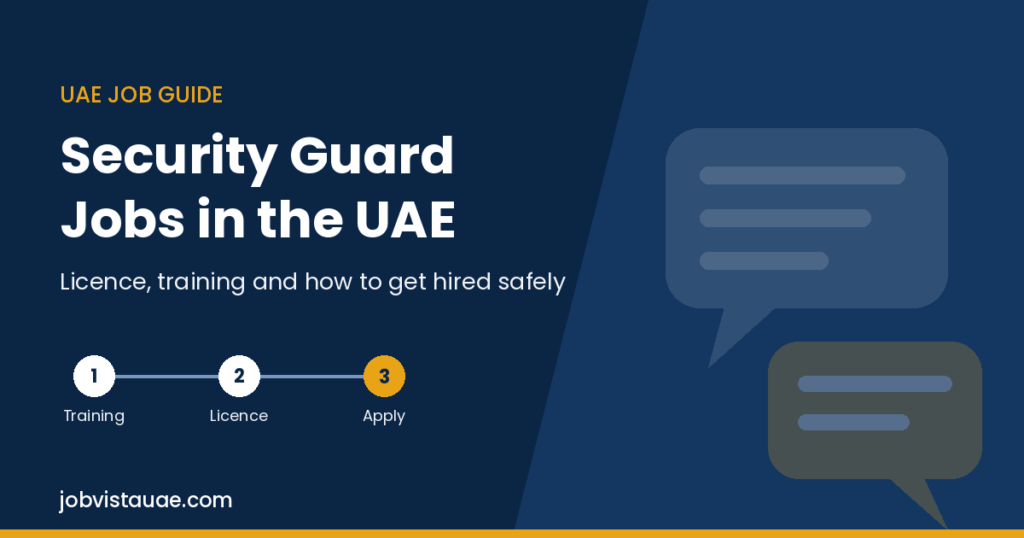
Getting a security guard job in the UAE comes down to three things: meeting the basic requirements, joining a licensed company that will sponsor your visa and training, and avoiding anyone who asks you to pay. Get those right and the licence follows.
For the wider job search, see our step-by-step guide to finding a job in UAE. When you are ready, browse the latest jobs in UAE or submit your CV.
Frequently asked questions
Do I need a SIRA card before applying for security guard jobs in Dubai?
Not usually. SIRA requires a licensed security company to apply for the card, and your residency must be with that company. So most new guards get the card after they join. An existing card can still help you start faster.
What is the age limit for a security guard licence in Dubai?
SIRA lists an age range of 21 to 60 for the Security Guard category. Individual employers may set a narrower range in their adverts.
Can I use my Dubai SIRA card in Abu Dhabi or Sharjah?
The SIRA card authorises private security work in the Emirate of Dubai. Other emirates license security staff through the Ministry of Interior and local police under federal law, so confirm with your employer what you need before you transfer.
Who pays for the security guard training and licence?
The licensed company applies for the licence and pays the service fee. UAE labour law also bans employers from charging workers recruitment and employment costs. Check your offer letter and ask in writing if anything is unclear.
Can women work as security guards in the UAE?
Yes. Malls, hospitals, hotels, schools and events often hire female guards, especially for searches and ladies-only areas. The licence requirements are the same.
How long is a SIRA security licence valid?
SIRA states that the Security Cadre Licence is valid for two years. Your employer handles the renewal.
This article is general information, not legal advice. Private security rules differ between emirates and change over time. Confirm current requirements with SIRA in Dubai, or with the Ministry of Interior or local police in other emirates, and with your employer before acting.