
Last updated:
Most candidates who lose a UAE job interview do not lose it on qualifications. They lose it on something smaller. Maybe a salary figure named too early. Perhaps a video call joined from a moving car. Or a confident answer to a question nobody asked.
The UAE market makes these errors expensive. A single vacancy in Dubai or Abu Dhabi can attract hundreds of applications. Interview panels are usually mixed-nationality. Employers also want to see that you understand how hiring works here. Small signals carry more weight than most candidates expect.
This guide covers the UAE job interview mistakes that come up most often. For each one, you get the signal it sends and the practical fix.
Why interview mistakes cost more in the UAE
Three things about this market raise the stakes.
Competition is dense. Employers rarely need to overlook a weak interview, because another shortlisted candidate usually has a similar profile.
Hiring involves paperwork. Your visa status, notice period and document readiness affect how fast an employer can onboard you. These points come up in the interview itself, not afterwards.
Teams are international. An answer that works well in one country can read as arrogant or evasive to a UAE panel. Those panels often draw on three or four different professional cultures.
Mistakes candidates make before the interview
Assuming you know the time, date and format
The UAE runs on Gulf Standard Time, four hours ahead of UTC. Candidates in India, Pakistan, the Philippines, Egypt and the UK often convert the time wrongly. They then miss the call, or join an hour early and reschedule.
Working weeks also vary between UAE employers. Government entities, free zone companies and private firms do not all keep the same days. A Friday or Sunday slot is neither automatically wrong nor automatically fine.
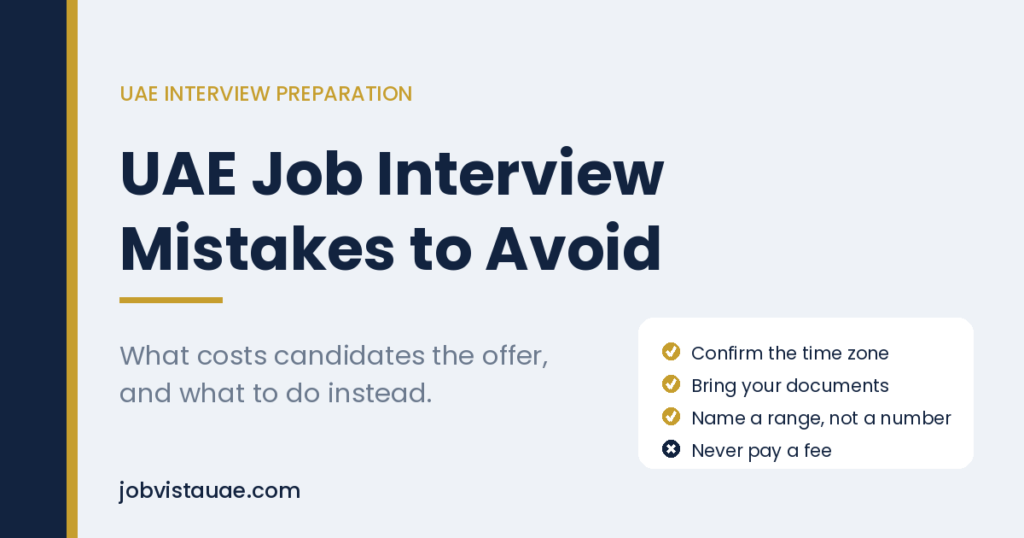
Do this instead: confirm five things in writing. The date, the start time in UAE time, the duration, the format and the interviewer’s name. A short email reply covers it, and it doubles as a record if the schedule changes.
Arriving without the documents an employer expects
UAE interviews often move faster than candidates anticipate. Employers commonly ask for documents at the first meeting. This happens most in operational and support roles, where employers want to shortlist the same week.
Do this instead: bring printed CV copies, your passport copy and copies of relevant certificates. Add your Emirates ID and visa page if you already live here. Keep the same set in a phone folder for online interviews.
Know your own numbers before you walk in. Interviewers will ask your visa status, your notice period and your earliest start date. Hesitating on any of them makes you look harder to hire.
Researching the role but not the employer
Reading the job description is not research. Candidates who skip everything else give themselves away instantly. The giveaway comes when an interviewer asks why they applied to this company.
Do this instead: spend fifteen minutes on the employer’s website and recent announcements. Look at the profiles of people doing similar work there. Note whether it is a mainland company, a free zone entity or a government-linked organisation. That structure often shapes how formal the interview feels.
Reusing an interview script from another market
An answer built for your home market assumes context a UAE panel does not have. Local employer names and industry acronyms mean nothing to an interviewer from elsewhere.
Do this instead: translate your experience into scale and outcome. “The largest private hospital group in the region, around 400 beds” beats a hospital name nobody recognises.
Mistakes candidates make during the interview
Rambling through “tell me about yourself”
No question in a UAE interview goes wrong more often. Candidates either recite their CV in date order for four minutes, or drift into personal biography.
Do this instead: keep it to about ninety seconds. Cover who you are professionally, what you have done that matters here, and why this role. Our guide on how to answer “tell me about yourself” in a UAE interview has sample answers.
Giving a generic answer to “why should we hire you?”
“I am hardworking, punctual and a fast learner” is the most forgettable answer in UAE recruitment. Every other shortlisted candidate says a version of it, so it carries no information.
Do this instead: name the specific problem in the job description. Then connect it to something you have actually done. Our guide to answering “why should we hire you” in a UAE job interview sets out the full framework.
Offering a rehearsed, fake weakness
Every experienced interviewer recognises “I am a perfectionist” and “I work too hard” as evasion. Worse, they suggest you lack self-awareness or will not be straight with the panel.
Do this instead: name a genuine, non-fatal weakness. Describe what you are actively doing about it. Our guide on the strengths and weaknesses question lists which weaknesses suit different roles.
Naming a salary figure before you have a range
Two versions of this mistake cost candidates money. The first is naming a number in the opening minutes, before you know the role. The second is quoting your total package when the employer means basic salary.
That distinction matters here. End-of-service calculations and several other entitlements follow the basic salary line, not the headline figure.
Do this instead: research a defensible range first. Answer with that range, and clarify which component you are quoting. Our guide on the salary expectations question covers four ways to respond.
Criticising a previous employer or colleague
The UAE professional community is smaller and more connected than it looks. Speaking badly about a former manager risks reaching someone who knows them. It also tells the interviewer how you might one day describe them.
Do this instead: describe what you were moving towards, not what you were escaping. “I wanted more direct client responsibility” is honest and gives the panel nothing to use against you.
Having no questions at the end
Saying “no, I think you covered everything” reads as low interest. The opposite mistake is leading with salary, leave and visa before showing any curiosity about the work.
Do this instead: prepare three or four questions and sequence them. Keep the role and team first, and save contract detail for later stages. Our guide to questions to ask the employer includes thirty examples by stage.
Dressing for the wrong kind of employer
A candidate in a full suit at an informal startup has made an error. So has a candidate in a polo shirt at a bank. Both spend the first minutes signalling that they misread the organisation.
Do this instead: match the employer type rather than one universal standard. Our UAE interview dress guide covers banks, government entities, hospitality, retail and startups.
Mistakes in online and recorded interviews
Video interviews are now standard for candidates applying from outside the country. The informality of the format tempts people into errors they would never make in an office.
- Joining from a car, a corridor or a shared space with movement behind you.
- Relying on mobile data for a call where a dropped connection ends the interview.
- Sitting with a bright window behind you, which turns your face into a silhouette.
- Reading answers off a second screen, which your eye movement gives away.
- Treating a one-way recorded interview as a rehearsal and submitting the first take.
Recorded formats deserve particular care. No interviewer is there to rescue a weak answer with a follow-up question. Our guide to online interview tips for UAE jobs covers camera setup and audio. You can also see how the process works on the JobVista UAE online interview page.
Mistakes at walk-in interviews
Walk-in interviews compress screening, interview and sometimes a decision into a single visit. The usual mistake is treating the day casually because nobody set a formal appointment.
Candidates commonly arrive without printed CVs and without passport-size photographs. Many also skip checking the exact venue, which in a large business district can mean a long walk. Arriving in the final hour is another avoidable error, because employers often stop once they have seen enough people.
If you plan to attend one, check current listings on the JobVista UAE walk-in interview page. Prepare exactly as you would for a scheduled meeting. Our walk-in interview tips list the documents to carry.
Mistakes candidates make after the interview
Never following up
Silence after an interview is not politeness. In a shortlist of similar candidates, a short professional message keeps you visible while the employer decides.
Do this instead: send a brief thank-you message within a day. Reference something specific from the conversation. If the interviewer gave you a timeline, wait until it passes before following up again.
Accepting verbally before reading the written offer
A verbal figure at the end of an interview is not an offer. Candidates who resign on the strength of a phone call risk a difficult position if the written terms differ.
Do this instead: ask for the offer in writing and read it against our UAE job offer letter checklist. Check that the basic salary, allowances, job title, working hours and probation terms match what you discussed. Our guide on how to verify a UAE job offer and employer walks through the checks.
The most expensive mistake: paying for an interview or a job
Every other mistake on this list costs you an opportunity. This one costs you money. It also targets candidates furthest along in their search and most eager to accept.
The UAE Government’s position is clear. Job seekers do not need to pay a recruitment agency, because responsibility for those fees sits with the employer. Find a role through a job portal, and you owe no commission to anyone.
Treat any of the following as a reason to stop and verify:
- A request for payment to secure an interview slot, process a visa or arrange a medical test.
- Offers of guaranteed placement in exchange for a fee.
- Interview invitations from a free email address rather than the organisation’s own domain.
- A recruiter who will only use a messaging app and avoids a call or an office address.
- Pressure to transfer money quickly before an offer expires.
The UAE Government’s guidance on searching for a job adds one more check. Make sure the email address sending you offers reflects the organisation’s own domain name. You can check licensed recruitment agencies with the Ministry of Human Resources and Emiratisation, which also handles complaints.
JobVista UAE does not charge candidates for applications or interviews. If a listing referring to our platform asks you for payment, please report it to our team.
A quick pre-interview checklist
| Stage | What to check | Why it matters |
|---|---|---|
| Scheduling | Date, UAE start time, format and interviewer name, all in writing | Prevents time zone errors and no-shows |
| Documents | Printed CVs, passport copy, Emirates ID and visa page, certificates | UAE shortlisting often moves within the same week |
| Your details | Visa status, notice period, earliest start date | Interviewers ask these during the interview, not after |
| Research | Employer type, recent activity, the actual problem in the role | Separates you from candidates who only read the advert |
| Answers | Opening summary, salary range, one genuine weakness | The three questions candidates most often get wrong |
| Questions | Three or four ready, in a sensible order | Signals interest without leading on pay and leave |
| Safety | Nobody asks a fee, sender domain matches the employer | Payment requests rank among the clearest warning signs |
Frequently asked questions
Is it a mistake to ask about salary in a first interview?
It is not a mistake to answer a salary question, since the employer often raises it first. It is a mistake to open with it. Let the interviewer introduce the topic, then respond with a researched range.
Should I mention that I am on a visit visa or job seeker visa?
Yes. Your status affects the employer’s onboarding timeline, and it will surface during document checks anyway. Stating it plainly, along with your availability, beats an employer discovering it later.
What should I do if I gave a bad answer during the interview?
If you notice in the moment, ask to return to the earlier question and give a clearer answer. If the interview has ended, add the missing point in a short follow-up message. Keep it to one paragraph.
How long should I wait before following up?
Send a thank-you message within about a day. If the interviewer gave you a decision date, wait for it to pass before enquiring. If nobody gave you a timeline, follow up after five to seven working days.
Is it a mistake to admit I do not know something?
No. Bluffing a technical answer carries the greater risk, particularly when the interviewer is a specialist. Say that you have not worked with something, then offer the closest relevant experience you do have.
Preparation is the part you control
You cannot control how many people applied or how strong the other candidates are. What you can control is whether you confirmed the time and brought the right documents. Researching the employer and knowing your salary range also sit entirely in your hands.
You fix almost every mistake in this guide in the hour before the interview, not in the room itself. That is the part worth your effort.
Work through the full question set on our UAE job interview questions page. Then browse the latest jobs in UAE and apply for roles that match your experience.

2 Comments