Last updated:
Got a UAE job offer? Before the authorities issue your residence visa, you will need to pass the UAE visa medical test, also called the medical fitness test. It is quick and routine for most people, but many guides online are out of date on what the test covers, what it costs and who pays.
This guide explains who needs the test, what it checks, where to take it in each emirate, the official fees, who should pay for it, and what happens if a result is not clear.
Last checked: November 2026. Sources: Cabinet Resolution No. 7 of 2008 as amended by Cabinet Resolution No. 75 of 2022, Cabinet Resolution No. 4 of 2025, Dubai Health, Emirates Health Services (EHS), the Abu Dhabi Department of Health and u.ae.
Who needs the UAE visa medical test?
Everyone aged 18 or above who applies for a UAE residence visa needs a medical fitness certificate. This includes new employment visas and every renewal. According to the federal resolution, the non-Emirati spouse, children and parents of a UAE national are exempt.
In addition, the certificate is valid for three months, and you also need valid health insurance. The medical test is one step in the wider visa process, which our UAE work visa process guide explains in order.
What does the UAE visa medical test check?
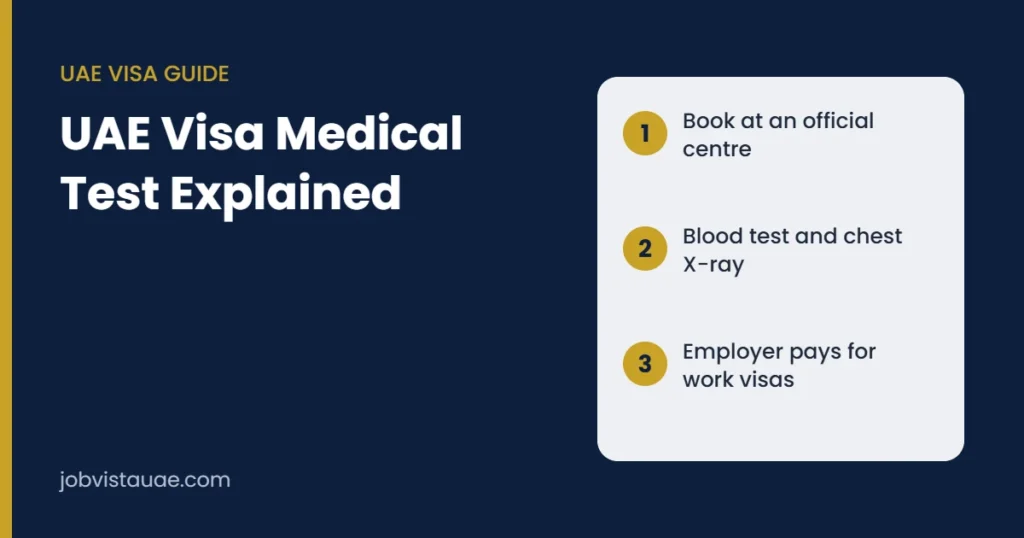
In most cases, the test involves a blood sample and a chest X-ray, plus a short physical check; for example, office staff usually need nothing more. However, the checks depend on your job category:
| Who | What is checked |
|---|---|
| All applicants | HIV, pulmonary tuberculosis (chest X-ray) and leprosy |
| Domestic workers, babysitters, nursery and kindergarten staff | Also hepatitis B and syphilis; a pregnancy test for domestic workers |
| Salon, barbershop, gym and health club workers | Also hepatitis B, hepatitis C and syphilis |
| Health facility workers | Also hepatitis B and C |
In practice, the job title on your visa application decides your test category. Some local authorities also screen food handlers, so confirm with the centre if you work in a restaurant or catering. Older articles say Dubai does not X-ray applicants. However, Dubai Health’s own process now lists a chest X-ray.
Where to take the test
- Dubai: Dubai Health runs a network of 25 medical fitness centres. You apply through the Salem portal, visit a centre and receive results by SMS or email.
- Abu Dhabi: SEHA screening centres and other Department of Health-approved providers. You can book through the SEHA visa screening app.
- Sharjah and the northern emirates: Emirates Health Services (EHS) centres. You apply with UAE PASS through the EHS website or app, and EHS also runs centres in Dubai.
On the day, bring your passport or Emirates ID, your e-visa or entry permit copy and a photo with a white background. After the test, results usually go directly to the immigration authority, so you rarely need to collect a paper report.
UAE visa medical test fees
| Provider | Service | Official fee |
|---|---|---|
| Dubai Health | Standard (24 working hours) | AED 270 |
| Dubai Health | Domestic workers (24 working hours) | AED 320 |
| Dubai Health | VIP (2 working hours) | AED 1,020 |
| EHS (other emirates) | Employees and workers | AED 250 plus printing fee |
| EHS | Salon, gym and health facility workers | AED 300 plus printing fee |
| EHS | Domestic workers, private drivers, nursery staff | AED 350 plus printing fee |
In Abu Dhabi, standard screening starts from about AED 250 at approved centres; check the current price with SEHA or your chosen centre. Typing centres may add their own service charges, and the amount shown at payment is final.
Who pays for the medical test?
For a mainland private-sector job, your employer should pay. The UAE Labour Law bars employers from charging workers recruitment and employment costs, and MoHRE’s “Know Your Rights” guide names medical tests and issuing your residency permit among the costs the employer must cover.
So if a recruiter or agent asks you to pay for your “visa medical”, ask why in writing. However, a separate law covers domestic workers, and free zone employers follow their own rules. Our job offer letter guide explains which costs your employer should cover.
What if a result is not clear?
Under the federal resolution, the authorities refuse or decline to renew a residence visa only after a confirmatory test. The outcome then depends on the condition:
- Tuberculosis at renewal: you can receive a certificate subject to treatment, with a shorter residence period and supervised treatment.
- Tuberculosis on a new visa: the resolution treats the applicant as unfit.
- Hepatitis in the listed jobs: the resolution gives time to change the job category on the visa.
- Syphilis: you receive treatment first, and the centre then issues the certificate.
- HIV and leprosy: residence is generally not granted or renewed, although the resolution allows exemptions for HIV in some cases.
An old scar on an X-ray or an unclear result often just means further tests. Above all, results are confidential, so ask the centre or your doctor to explain any next steps.
Frequently asked questions
Do I need to fast before the UAE visa medical test?
Usually, you do not need to fast. Wear clothing that is easy to remove for the chest X-ray.
How long do results take?
Standard results take about 24 working hours in Dubai and through EHS. Faster paid options exist in Dubai.
Do I need the medical test when I renew my visa?
Yes. Applicants aged 18 and above need a new medical fitness certificate for every residence visa renewal.
Can I take the test if I am pregnant?
Yes. Tell the centre before your appointment, because pregnant applicants are usually not X-rayed and follow a different process.
Book early, keep your receipt
In short, book your medical test as soon as your entry permit is ready, use an official centre, and keep the receipt for your employer. For a mainland job, your employer should pay for it.
Still looking for your next role? Browse the latest jobs in UAE or read our UAE job seeker visa guide.
This guide summarises Cabinet Resolution No. 7 of 2008 as amended, Cabinet Resolution No. 4 of 2025, and the official Dubai Health, EHS and Abu Dhabi Department of Health pages, as checked in November 2026. It is general information, not medical or legal advice. Fees and procedures can change, so confirm with the testing centre.