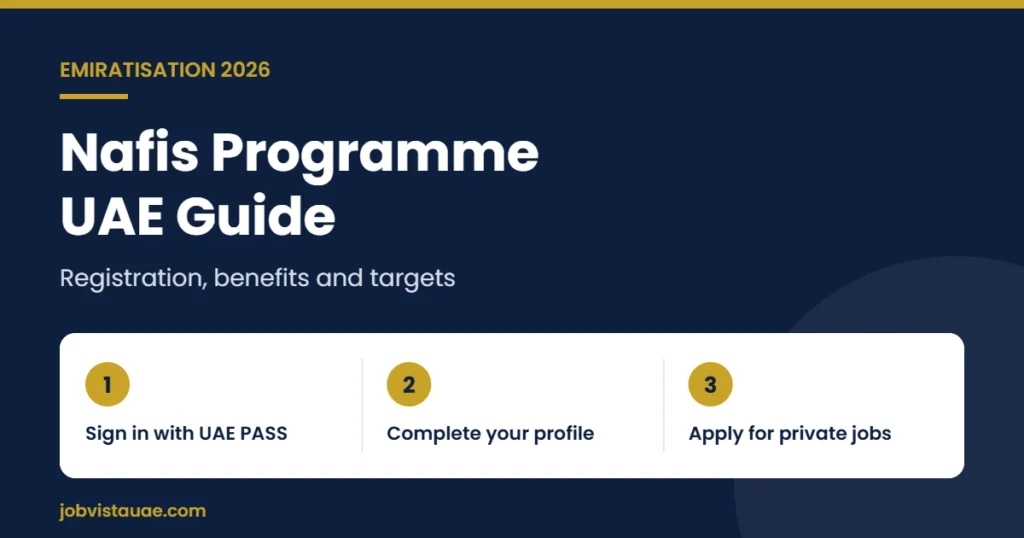
Nafis is the UAE’s federal programme to help Emiratis build careers in the private sector. In practice, it connects UAE nationals with private-sector jobs, supports their salaries and families, and funds training. Moreover, the UAE has now extended Nafis to 2040, and a new benefits framework started in September 2026. As a result, many older guides are now out of date.
For that reason, this guide explains how Nafis works in 2026, how to register, what support Emiratis can receive, and what the Emiratisation targets mean for private-sector employers and job seekers.
Last checked: November 2026. Sources: nafis.gov.ae, the Emirati Talent Competitiveness Council (ETCC), MoHRE, WAM and the UAE Government portal (u.ae).
What is Nafis?
The Emirati Talent Competitiveness Council (ETCC) runs Nafis. Originally, the programme launched in September 2021 as one of the “Projects of the 50”, with AED 24 billion allocated over five years. Then, in April 2026, the government extended it to 2040.
Overall, according to ETCC, Nafis had helped more than 176,000 Emiratis into jobs by the end of March 2026, across about 32,000 private-sector companies.
How to register on Nafis
- Check you are eligible. First, note that registration is for UAE nationals aged 18 to 60.
- Sign in with UAE PASS on nafis.gov.ae. For this, you need a verified UAE PASS account linked to your Emirates ID.
- Complete your profile. Then add your education, experience and the jobs you want.
- Review your eligibility. Next, the platform checks automatically which benefits may apply to you.
- Apply for Nafis jobs. Finally, private-sector employers post vacancies on the platform every day.
Best of all, registration is free. If you need help, the Nafis helpline is 800 62347. In addition, free zone job profiles may need manual approval.
Nafis benefits from September 2026
In April 2026, the ETCC announced an updated benefits framework, which applies to new beneficiaries from September 2026. In summary, the main elements are:
| Benefit | What it offers (from September 2026) |
|---|---|
| Salary support | Up to AED 6,000 a month with a bachelor’s degree, AED 5,000 with a diploma and AED 4,000 with a secondary school certificate. The salary must be between AED 6,000 and AED 20,000. |
| Child allowance | AED 600 a month per eligible child, with no cap on the number of children, for parents earning AED 6,000 to AED 50,000 in the private sector |
| Pension support | Nafis continues to support the employee’s pension contribution; employers pay their full share |
| Unemployment benefit | AED 7,000 a month, plus an amount for a non-working spouse, for up to 12 months within five years |
| Training | Programmes such as the Talent Programme, the National Healthcare Programme and teacher training programmes |
Meanwhile, existing beneficiaries move to the new salary support levels gradually, with support reducing by AED 500 every six months until it reaches the new level. Always check your own entitlement on the Nafis platform, because conditions apply to each benefit.
Emirati minimum wage: AED 6,000
From 1 January 2026, MoHRE set a minimum monthly wage of AED 6,000 for Emiratis in the private sector. However, employers had until 30 June 2026 to adjust existing contracts. Since 1 July 2026, Emiratis paid below that level no longer count towards a company’s Emiratisation target.
Emiratisation targets for private companies
Companies with 50 or more employees
Under MoHRE rules, these companies must raise the share of Emiratis in skilled jobs by 2% a year: 1% by 30 June and 1% by 31 December. As a result, the share reaches 10% by the end of 2026, according to MoHRE. In addition, for 2026 the financial contribution for each unfilled position is AED 10,000 a month, or AED 120,000 a year.
Companies with 20 to 49 employees
Separately, companies of this size in 14 specified sectors had to employ one Emirati by the end of 2024 and two by the end of 2025. The contribution for missing the 2025 target was AED 108,000, collected in January 2026.
Penalties for fake Emiratisation
MoHRE treats “sham” Emiratisation, such as hiring an Emirati on paper only, as a serious violation. Specifically, under Cabinet Decision No. 43 of 2025, fines range from AED 20,000 to AED 100,000 per worker, and MoHRE can suspend the beneficiary’s Nafis support. Therefore, report violations to MoHRE on 600 590000.
What Emiratisation means for expat job seekers
Because Emiratisation targets apply to skilled roles in larger companies, some employers now reserve certain positions for UAE nationals. For example, you may see this in job adverts. However, the targets do not stop companies hiring expatriates; the private sector still recruits heavily from abroad. For expat candidates, the practical step is to focus on roles where your specialist skills and experience add clear value.
Avoid fake Nafis job offers
First, remember that Nafis registration is free, and genuine employers do not charge candidates for a job. So be careful with anyone who offers to “register” you, guarantee benefits or arrange a Nafis job for a fee. Use only nafis.gov.ae with UAE PASS, and read our guide to UAE job scams for warning signs.
Frequently asked questions
Who can register on Nafis?
UAE nationals aged 18 to 60 can register on nafis.gov.ae, as long as they sign in with UAE PASS.
Is Nafis salary support paid on top of my salary?
Yes. Eligible Emiratis receive salary support in addition to the salary their private-sector employer pays, depending on their qualification and salary level.
Does Emiratisation apply to free zone companies?
In general, the MoHRE targets apply to private companies registered with MoHRE. Still, check with MoHRE or your free zone authority for the rules that apply to a specific company.
Start your private-sector career
In short, Emiratis should register on Nafis with UAE PASS, check their eligibility, and apply for private-sector jobs on the platform. Meanwhile, employers should plan for the 2026 targets and the AED 6,000 minimum wage. Finally, before you sign any offer, read our UAE job offer letter guide.
Explore opportunities: browse the latest jobs in UAE or submit your CV.
This guide summarises Nafis, ETCC, MoHRE and WAM information as checked in November 2026. However, benefit amounts and conditions can change, and eligibility rules apply. Confirm your own entitlement on nafis.gov.ae or with MoHRE. JobVista UAE is not affiliated with Nafis or any government entity.