Working hours in UAE private-sector jobs follow clear federal limits. Your employer cannot set any schedule it likes, and every extra hour you work has a legal price. Yet many employees never check their hours against the law, and some lose overtime pay because of it.
This guide explains the daily and weekly limits under Federal Decree-Law No. 33 of 2021, how to calculate overtime, the rules on breaks and rest days, Ramadan hours, and the summer midday break.
Working hours in UAE: the quick answer
| Rule | Private sector limit |
|---|---|
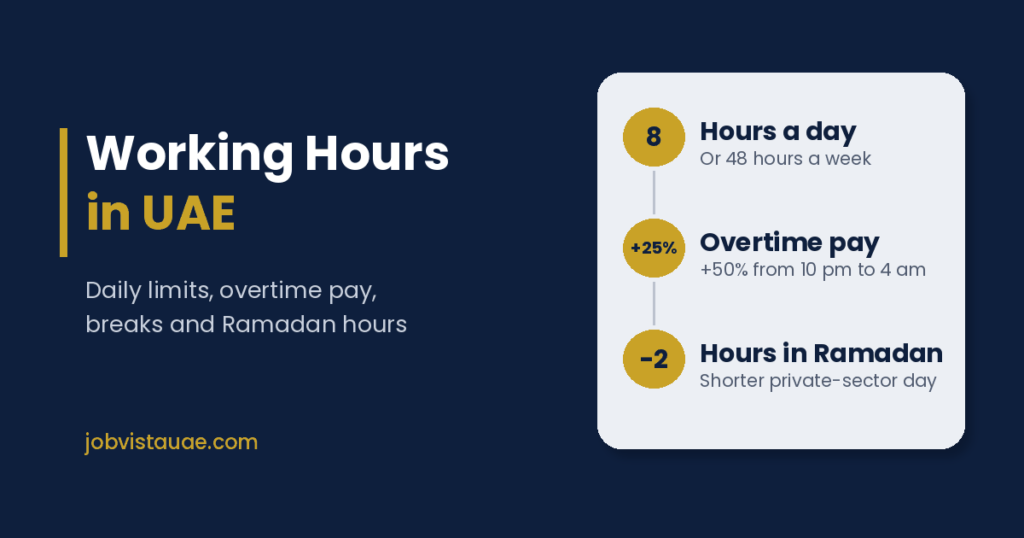
| Normal working hours | Up to 8 hours a day or 48 hours a week |
| Rest break | At least 1 hour in total after 5 consecutive hours |
| Overtime limit | Up to 2 hours a day; total hours capped at 144 every 3 weeks |
| Overtime pay | Basic hourly wage plus at least 25% |
| Overtime between 10 pm and 4 am | Basic hourly wage plus at least 50% (shift workers excluded) |
| Work on your rest day | Another rest day, or the day’s wage plus at least 50% of basic wage |
| Weekly rest | At least 1 paid day |
| Ramadan | 2 hours shorter per day |
| Summer midday break | No outdoor work under the sun from 12:30 pm to 3 pm, 15 June to 15 September |
Normal working hours under UAE Labour Law
Article 17 of the Labour Law sets the maximum normal working hours at 8 hours a day or 48 hours a week. Many offices work fewer hours, often 40 to 45 a week, but the law sets the ceiling, not the standard.
A few further points in Article 17 matter in practice:
- Commuting time does not count. Travel between home and work is not working time, except for some categories set out in the Executive Regulation.
- Your contract sets your hours. If you work full time, your employer cannot make you work more than the hours in your contract without your written consent.
- Remote work can have set hours. If your employer approves remote work, it can still require specific working hours.
- The Cabinet can change limits for particular sectors or categories of worker.
Check the hours in your offer before you sign. Our UAE job offer letter checklist shows what to look for, and our labour contract guide explains how to confirm the hours MoHRE has on record.
Breaks: is lunch included in working hours?
Under Article 18, you cannot work more than 5 consecutive hours without a rest period, or several periods, that add up to at least one hour. u.ae adds that these breaks do not count as working time.
In practice, a 9 am to 6 pm day with a one-hour lunch break equals 8 working hours, within the legal limit. Shift-based workplaces and field jobs can organise breaks differently under the Executive Regulation.
Weekly rest day
Article 21 gives every worker at least one paid rest day a week. Your contract or the company’s work regulations set which day it is. Many private-sector employers give two days, but the legal minimum is one.
Overtime in UAE: limits and pay
Article 19 lets an employer ask you to work beyond normal hours, but within limits:
- Overtime should not exceed 2 hours a day, except under conditions in the Executive Regulation.
- Total working hours, overtime included, must not exceed 144 hours every 3 weeks.
- Your employer cannot make you work more than two consecutive rest days, except for day labourers.
The law sets these minimum overtime rates:
| When you work extra | Minimum pay |
|---|---|
| Normal overtime | Your basic hourly wage plus at least 25% |
| Overtime between 10 pm and 4 am | Your basic hourly wage plus at least 50% (does not apply to shift workers) |
| Working on your rest day | A replacement rest day, or the day’s normal wage plus at least 50% of the basic wage |
How to calculate overtime in UAE
The law calculates overtime on your basic wage, not your total salary. Allowances such as housing and transport do not count. That is why the basic salary line in your offer matters so much. Our UAE salary guide explains how basic salary and allowances differ.
The law does not set a formula for the hourly rate. Many employers divide the monthly basic salary by 30 days and then by 8 hours. As an illustration, with a basic salary of AED 4,800:
- Basic hourly wage: AED 4,800 ÷ 30 ÷ 8 = AED 20
- Normal overtime rate: AED 20 + 25% = AED 25 an hour
- Night overtime rate (10 pm to 4 am): AED 20 + 50% = AED 30 an hour
- 10 normal overtime hours in a month: 10 × AED 25 = AED 250
Your employer may use a different divisor, so ask HR how it calculates your rate and check your payslip each month. Overtime you earned but never received also belongs in your final settlement when you leave, as our resignation and final settlement guide explains.
Who the working hours rules may not cover
Article 20 lets the Executive Regulation exempt some categories of worker from the working hours provisions. If your contract says the standard hours or overtime rules do not apply to your role, ask HR which category it relies on and get the answer in writing.
Working hours during Ramadan
Article 17 leaves Ramadan hours to the Executive Regulation, and MoHRE announces the arrangement each year. For Ramadan 2026, MoHRE confirmed that normal working hours for private-sector employees fall by two hours a day. It also allowed companies to use flexible or remote work within the reduced daily hours.
For an employee on an 8-hour day, that means a 6-hour day during Ramadan. If you work beyond the reduced hours, the extra time counts as overtime. MoHRE normally announces the arrangement shortly before Ramadan begins, so check its announcement each year.
The summer midday break
Ministerial Resolution No. 44 of 2022 bans work directly under the sun and in open places between 12:30 pm and 3 pm from 15 June to 15 September, according to u.ae. The rule protects construction, delivery and other outdoor workers during the hottest hours.
If your employer makes you work outdoors during those hours, you can report it to MoHRE on 600590000 or through the MoHRE app.
Part-time and flexible work
The 2021 Labour Law recognises several work models beyond full-time employment, including part-time, temporary and flexible work. The hours you work under these models still need to match what your contract and MoHRE record say. A full-time employee can only work extra hours for the same or another employer with written consent.
What to do if your hours or overtime are wrong
- Keep a record. Note your start and finish times, and keep any emails or messages asking you to stay late.
- Check your payslip. Make sure each payslip lists your overtime hours and the rate applied.
- Raise it with HR in writing and quote Article 19 of the Labour Law.
- File a complaint with MoHRE if HR does not fix it. Use the MoHRE app, website or call centre on 600590000.
Unpaid overtime is a wage issue. Our guide to the UAE salary payment rule explains how MoHRE treats late or missing pay.
Working hours in UAE: frequently asked questions
How many working hours does UAE law allow per day?
Up to 8 hours a day or 48 hours a week as normal working hours. Overtime can add up to 2 hours a day, within a total of 144 hours every 3 weeks.
Is lunch break included in working hours in UAE?
No. You get at least one hour of rest after 5 consecutive hours of work, and u.ae states that breaks do not count as working time.
How is overtime calculated in UAE?
On your basic wage. You receive your basic hourly wage plus at least 25%, or plus at least 50% for overtime between 10 pm and 4 am, unless you work shifts.
Can my employer make me work on my day off?
Yes, if work requires it, but you must receive another rest day or the day’s wage plus at least 50% of your basic wage. Your employer cannot make you work more than two rest days in a row.
What are working hours in Ramadan in UAE?
For Ramadan 2026, MoHRE cut private-sector working hours by two hours a day. MoHRE confirms the arrangement each year before Ramadan.
Know your hours, protect your pay
The rules on working hours in UAE are simple once you know them: 8 hours a day, a break after 5 hours, overtime at 25% or 50% extra on your basic wage, and shorter days in Ramadan. Check your contract and payslips against these limits, and raise problems early.
Looking for an employer that respects these rules? Browse the latest UAE jobs or submit your CV.
This guide summarises Federal Decree-Law No. 33 of 2021, MoHRE announcements and u.ae as checked in October 2026. It is general information, not legal advice. For your own situation, contact MoHRE or a qualified UAE employment lawyer.