
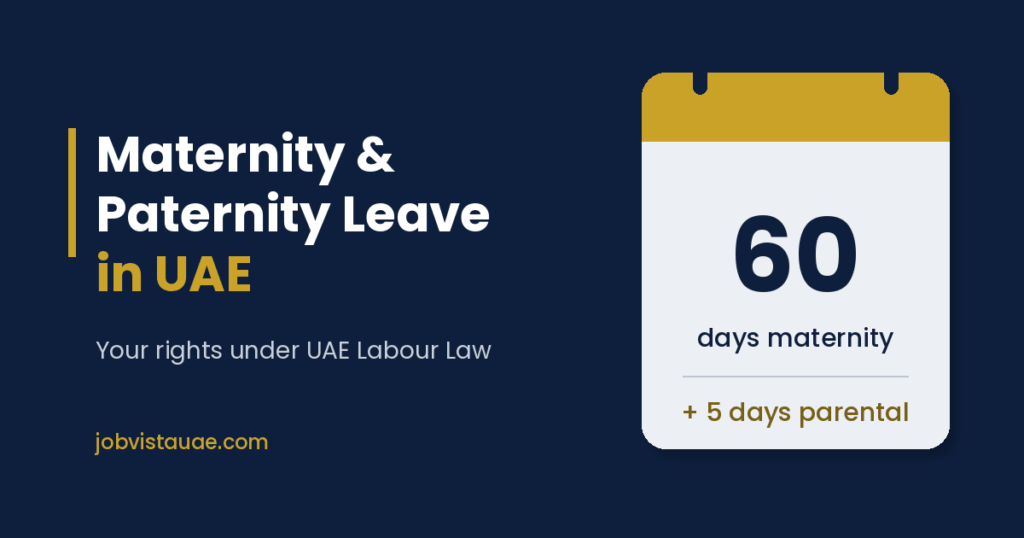
Federal law, not company policy, sets maternity leave in UAE private-sector jobs. If you are expecting a baby, or your partner is, you should know exactly what the law gives you. Knowing when leave can start, how much of it carries pay, and what an employer cannot do because of pregnancy will help you plan with confidence.
This guide covers maternity and paternity leave in the UAE under Federal Decree-Law No. 33 of 2021, the law that governs most private-sector employment. It also explains how the rules differ for federal government employees and for workers in the DIFC and ADGM free zones.
Maternity and paternity leave in UAE: the quick answer
| Entitlement | Private sector (Decree-Law 33 of 2021) |
|---|---|
| Maternity leave | 60 days: 45 days on full pay, then 15 days on half pay |
| Extra leave if mother or baby is ill from pregnancy or birth | Up to 45 days unpaid, with a medical certificate |
| Baby born sick or with a disability | 30 extra days on full pay, plus an optional 30 days unpaid |
| Nursing breaks | One or two breaks a day, up to one hour in total, for six months after birth |
| Parental (paternity) leave | 5 working days paid, for the father or the mother, within six months of birth |
| Earliest start of maternity leave | The last day of the month before the month the baby is due |
| Dismissal protection | No termination or notice because of pregnancy or maternity leave |
How much maternity leave you get in the UAE
Under Article 30 of the Labour Law, a female employee gets 60 days of maternity leave. She receives full pay for the first 45 days and half pay for the next 15.
Article 30 sets no minimum length of service for this entitlement. The older labour law linked full maternity pay to one year of service, and many online articles still repeat that condition. The current law does not include it. If you are still on probation when you need maternity leave, ask HR to confirm the arrangement in writing. Our guide to the probation period in UAE explains how probation works in general.
How maternity pay works in practice
The law says “full pay” and “half pay”. It does not limit these to basic salary, unlike the gratuity rules and the cash-in rule for unused annual leave, which refer to basic salary specifically.
As a simple illustration, suppose your monthly salary is AED 9,000 and your employer works out a daily rate over a 30-day month (AED 300 a day):
- 45 days at full pay: 45 × AED 300 = AED 13,500
- 15 days at half pay: 15 × AED 150 = AED 2,250
- Total paid over the 60 days: AED 15,750
If your payslip shows maternity pay worked out on basic salary only, ask HR which provision they are relying on. You can raise it with the Ministry of Human Resources and Emiratisation (MoHRE) if you cannot resolve it. Salary during leave should still arrive through the Wage Protection System on the normal date.
When maternity leave can start
Your employer must grant maternity leave whenever you ask for it, from the last day of the month before the month your baby is due. You need a certificate from the medical authority confirming the expected date.
For example, if your due date is 20 March, you can start maternity leave on the last day of February. You can also start later, and many mothers work closer to the due date so that more of the 60 days fall after the birth. Agree the start date with your employer in writing.
If a baby dies before or after birth
The law protects mothers in this situation. A woman who gives birth after six months or more of pregnancy still gets the full 60 days of maternity leave, whether the baby dies before or after birth.
Extra leave after maternity leave ends
Some families need more time. The law provides two separate extensions.
Up to 45 days unpaid if you or your baby is unwell
After your maternity leave, you may take up to 45 more days without pay, all at once or split up. This applies when an illness caused by pregnancy or childbirth, in you or your child, prevents you from returning to work. A medical certificate from the medical authority must prove the illness.
One detail is easy to miss: these unpaid days do not count towards your service period for end-of-service gratuity. Our UAE gratuity calculation guide shows how the service period affects what you receive when you leave.
30 paid days for a baby who needs constant care
If your baby has an illness or disability at birth and needs a constant companion, you can take 30 days of leave on full pay, starting after maternity leave ends. A medical report from the medical authority must confirm the need. You can then extend this by another 30 days without pay.
Taking maternity leave or these extensions does not affect your right to other leave. Your annual leave still builds up in the normal way. Read our annual leave in UAE guide if you are thinking of adding annual leave to the end of maternity leave.
Nursing breaks when you return to work
For six months from the date of birth, a mother who has returned to work may take one or two rest breaks a day to breastfeed. Together they must not exceed one hour a day.
The private-sector article does not say who sets the timing of these breaks. In practice, many mothers arrange to start an hour later or finish an hour earlier. Agree the pattern with your manager and HR in writing, so there is no dispute later about working hours or pay.
Paternity leave in UAE: the 5-day parental leave
The UAE Labour Law calls it parental leave, but most people search for it as paternity leave. Under Article 32, the law gives any worker who has a child, whether the father or the mother, 5 working days of paid leave to care for the child.
- Length: 5 working days, not calendar days, so weekends do not use them up.
- Pay: full pay.
- Timing: any time within six months of the child’s birth.
- Flexibility: you can take the days together or spread them out.
- Proof: the law requires proof from the relevant authorities, which in practice usually means the birth certificate.
Because the law gives parental leave to the father or the mother, a mother can take these 5 days as well as her maternity leave. The law says maternity leave does not affect her right to other leave types.
How the law protects your job during pregnancy and maternity leave
Article 30 states that an employer may not terminate a female employee, or give her notice, because of pregnancy, because she took maternity leave, or because she took the extra leave described above.
Two further rules support this protection:
- Notice cannot run during leave. Under Article 35, if either side ends the contract while the employee is on leave, the notice period starts only the day after she is due back, unless both sides agree otherwise.
- No discrimination. Article 4 bans discrimination on the grounds of sex in hiring, keeping a job and enjoying its rights, and requires equal pay for women doing the same work or work of equal value.
These rules do not stop an employer from ending a contract for a lawful reason unrelated to pregnancy. If you believe the real reason was your pregnancy, keep every email and letter. Our termination of employment guide explains what your employer owes you. Our MoHRE contract and complaint guide shows how to file a labour complaint.
One rule that works against the employee
If you work for another employer during your maternity leave or the extensions, your original employer can withhold your pay for that period or recover what it has already paid. Do not take on paid work elsewhere while on leave.
Government employees and DIFC or ADGM staff
The 60-day rule applies to the private sector. Other employers follow different laws.
| Employer type | Governing rules | Maternity leave | Parental leave |
|---|---|---|---|
| Private sector (mainland and most free zones) | Federal Decree-Law 33 of 2021 | 60 days (45 full pay, 15 half pay) | 5 working days |
| Federal government (permanent posts) | Federal Decree-Law 49 of 2022 | 90 days on full pay | 5 working days |
| Local governments (Abu Dhabi, Dubai, Sharjah, RAK) | Each emirate’s own HR law | Varies by emirate | Varies by emirate |
| DIFC and ADGM | Their own employment laws | Different rules; check your authority | Different rules; check your authority |
According to u.ae, federal government mothers may also take up to two hours a day for nursing for six months after maternity leave ends. That is double the private-sector allowance.
If you are comparing job offers from a government entity and a private company, leave rules are a real part of the package. Our UAE job offer letter checklist covers what to confirm before you sign.
How to apply for maternity or paternity leave: a checklist
- Tell HR early. The law does not set a notice deadline, but early notice makes handover and cover easier.
- Get the medical certificate showing your expected due date. Your employer needs it before approving leave from the month before the birth.
- Put your start and return dates in writing, including any annual leave you plan to add.
- Ask how your employer will calculate maternity pay and check your first payslip against it.
- Agree your nursing-break arrangement before you return.
- Fathers: submit the birth certificate and book your 5 working days within six months of the birth.
- Keep copies of every request, approval and payslip in case you need them later.
What to do if your employer refuses
Start with a written request to HR that quotes the relevant article: Article 30 for maternity leave, or Article 32 for parental leave. Many disputes end at that stage.
If the employer still refuses leave, cuts pay below the legal level, or dismisses you because of pregnancy, you can file a complaint with MoHRE. Use the MoHRE app, the website or the call centre on 600590000. Check first that MoHRE holds the correct contract for you, because it works from that registered record. Our guide to checking your labour contract explains how.
Maternity leave in UAE: frequently asked questions
How many days is maternity leave in UAE for the private sector?
60 days. The first 45 days are on full pay and the following 15 days are on half pay, under Article 30 of Federal Decree-Law No. 33 of 2021.
Is paternity leave paid in the UAE?
Yes. Private-sector workers get 5 working days of paid parental leave, which fathers commonly use as paternity leave. You must take it within six months of the child’s birth.
Do I need one year of service to get maternity leave?
No. The current law sets no minimum service period for maternity leave. The one-year condition came from the old labour law, which the 2021 Decree-Law replaced.
Can my employer fire me while I am pregnant?
Your employer cannot dismiss you or give you notice because you are pregnant or took maternity leave. If the contract ends for another lawful reason while you are on leave, the notice period starts only after your scheduled return date.
Can I add annual leave to my maternity leave?
Yes, with your employer’s agreement on the dates. Maternity leave does not reduce your other leave entitlements, so many employees add annual leave straight after it.
How long are breastfeeding hours in UAE?
Private-sector mothers can take one or two breaks a day, up to one hour in total, for six months from the birth. Federal government employees can take up to two hours a day.
Plan your leave with confidence
UAE maternity and paternity leave is a legal right with clear numbers: 60 days for mothers, 5 working days of parental leave for either parent, and firm protection against pregnancy-related dismissal. Agree your dates and pay in writing, and you will avoid most of the problems families run into.
If you are weighing up your next move, family-friendly terms are worth asking about at the offer stage. Browse the latest UAE jobs or submit your CV to hear about roles that suit you.
This guide summarises Federal Decree-Law No. 33 of 2021 and official UAE government information as checked in September 2026. It is general information, not legal advice. For your own situation, contact MoHRE or a qualified UAE employment lawyer.

1 Comment