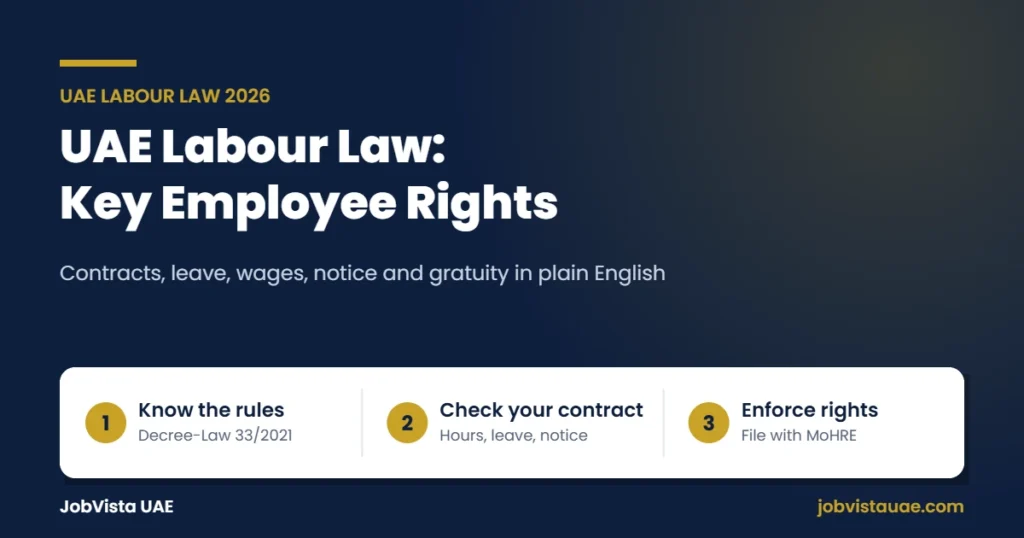
The UAE labour law sets the minimum rights of every private-sector employee on the mainland, from probation and working hours to leave, notice and end-of-service gratuity. Yet many articles still quote the old 1980 law, unlimited contracts or rules that changed in 2024 and 2026.
Therefore, this guide summarises the current UAE labour law in plain English. Each section gives the key rule and its article number, then links to our detailed guide on that topic.
Last checked: 22 November 2026. Sources: MoHRE’s English text of Federal Decree-Law No. 33 of 2021 and its amendments, the UAE Government portal (u.ae) and UAE media.
Which law applies in 2026?
Today, the main law is Federal Decree-Law No. 33 of 2021, which took effect on 2 February 2022. In addition, its Executive Regulation is Cabinet Resolution No. 1 of 2022. Since then, two key amendments have followed:
- 2022: first, the three-year cap on fixed-term contracts was removed.
- 2024 (Federal Decree-Law No. 9 of 2024): MoHRE now decides labour claims up to AED 50,000, claims can be filed up to two years after the job ends, and employer fines rose to AED 100,000–1,000,000.
In addition, MoHRE’s Ministerial Resolution No. 340 of 2026 changed the salary payment deadline from 1 June 2026. For details, see our guide to the new salary rule.
Who the law covers
In general, the law covers private-sector employers and employees on the UAE mainland and in most free zones. However, the DIFC and ADGM free zones have their own employment laws, domestic workers fall under a separate law, and government employees follow civil service rules.
UAE labour law at a glance
| Topic | Key rule | Article |
|---|---|---|
| Contract | Fixed-term, renewable, no maximum length | 8 |
| Probation | Up to 6 months, and only once per employer | 9 |
| Working hours | Normally, 8 a day or 48 a week | 17 |
| Overtime | Basic wage plus at least 25% (50% from 10 pm to 4 am) | 19 |
| Annual leave | 30 days a year, after one year of service | 29 |
| Sick leave | Up to 90 days a year, but only after probation | 31 |
| Maternity leave | 60 days in total (45 full pay, then 15 half pay) | 30 |
| Notice period | 30 to 90 days | 43 |
| Gratuity | 21 days’ basic wage a year for 5 years, then 30 | 51 |
| Deductions | In total, capped at 50% of the wage | 25 |
Employment contracts and probation
Every mainland contract is now a fixed-term contract that can be renewed, and the law also allows full-time, part-time, temporary, flexible, remote and job-sharing models. So “unlimited” contracts no longer exist. Our guide to limited and unlimited contracts explains the change, and our contract check guide shows how to confirm yours with MoHRE.
Under Article 9, probation lasts up to six months. The employer must give 14 days’ notice to end it, while you give one month to join another UAE employer or 14 days to leave the country. For the details, read our probation period guide.
Working hours, rest and overtime
Normal hours are 8 a day or 48 a week (Article 17), with breaks totalling at least one hour so that you do not work more than five hours in a row. Overtime is limited to two hours a day, and you get at least one paid rest day a week. Also, our working hours guide covers overtime pay and Ramadan hours.
Leave entitlements
- Annual leave (Article 29): 30 days a year, or 2 days a month after six months. See our annual leave guide.
- Sick leave (Article 31): 15 days full pay, 30 days half pay and 45 days unpaid, but none paid during probation. See our sick leave guide.
- Maternity and parental leave (Articles 30 and 32): 60 days for mothers, plus 5 working days of parental leave for either parent. For more, see our maternity and paternity leave guide.
- Public holidays (Article 28): paid days off set by the Cabinet. For dates, see our UAE public holidays list.
The law also gives bereavement leave and, after two years of service, 10 days of study leave a year.
Wages and salary protection
In practice, most private-sector employees receive pay through the Wage Protection System. Under the current rules, salary is due on the 1st of each month, and MoHRE acts against late payers from day 2. Meanwhile, Article 25 limits deductions, with a total cap of 50% of the wage.
There is no general minimum wage for all workers, although Emiratis in the private sector have a minimum of AED 6,000 a month from 1 January 2026. For more, our guides to WPS salary, basic salary and the UAE salary guide explain how pay works.
Resignation, termination and gratuity
First, either side must give 30 to 90 days’ written notice under Article 43. However, Article 44 lets an employer dismiss without notice for serious misconduct, such as forged documents or long unauthorised absence. Likewise, Article 45 lets you leave without notice in limited cases, such as unpaid wages that MoHRE has been told about, or assault at work.
If a court finds a dismissal arbitrary, compensation is capped at three months’ wage (Article 47). That is a maximum, not an automatic payout. Our step-by-step guides to resignation and notice and termination of employment cover each case.
After at least one year, you earn end-of-service gratuity on your basic wage under Article 51, and resigning no longer reduces it. To work it out, use our gratuity guide or the gratuity calculator.
Other employee protections
- No recruitment fees (Article 6): your employer may not charge you recruitment costs.
- No passport retention (Article 13): similarly, your employer must not keep your official documents.
- Free experience certificate (Article 13): you can request one at any time. See our experience certificate guide.
- Equal treatment (Article 4): in addition, the law bans discrimination and gives women equal pay for work of equal value.
- Non-compete (Article 10): a clause can last up to two years after the contract ends.
How to enforce your rights
Start with MoHRE. Under Article 54, MoHRE handles labour complaints first and issues decisions on claims up to AED 50,000. Moreover, you can file up to two years after your job ends. Our step-by-step guide shows how to file a MoHRE labour complaint, and our ILOE guide explains unemployment insurance if you lose your job.
Common UAE labour law myths
- “Unlimited contracts still exist.” No, the law converted them to fixed-term contracts.
- “You always get three months’ salary if you are fired.” No, that is only the maximum for an arbitrary dismissal.
- “Resigning cuts your gratuity.” Not any more; that rule came from the old 1980 law.
- “You need an NOC to change jobs.” In fact, the current law does not include that requirement. Our guide to changing jobs explains what you do need.
Frequently asked questions
What is the current UAE labour law?
Federal Decree-Law No. 33 of 2021, as amended in 2022 and 2024, with its Executive Regulation, Cabinet Resolution No. 1 of 2022.
Does the UAE labour law apply in free zones?
In most free zones, yes. However, the DIFC and ADGM have their own employment laws.
Where can I report a labour law violation?
First, contact MoHRE through its app, website or call centre on 600590000.
Know your rights before you need them
In short, the UAE labour law gives every private-sector employee clear minimum rights. So read your contract, keep your payslips, and use MoHRE if something goes wrong. Finally, bookmark this page as your starting point for each topic.
Looking for an employer that respects your rights? Browse the latest jobs in UAE or submit your CV.
This guide summarises MoHRE’s English text of Federal Decree-Law No. 33 of 2021 and its amendments, u.ae and UAE media as checked on 22 November 2026. The Arabic text is authoritative, and free zones such as DIFC and ADGM have their own rules. Confirm your situation with MoHRE on 600590000. It is general information, not legal advice.