
Yes, you can change jobs in UAE without leaving the country, and in most cases you do not need your current employer’s permission to do it. What you do need is the right order of steps. Resign before you have a signed offer, start work before your new permit is issued, or walk out without serving notice, and a simple job move can turn into a fine, a dispute or a one-year work permit ban.
This guide is for expat employees in the private sector, mainly on the mainland, with notes on free zones. It sets out the official rules, the order to do things in, and where each step is explained in more detail on JobVista UAE.
Last checked: October 2026. Rules are taken from Federal Decree-Law No. 33 of 2021, its Executive Regulation and MoHRE and u.ae service pages.
How to change jobs in UAE: the short version
- Check your registered contract for your notice period, probation status and any non-compete clause.
- Get a written offer from the new employer on the official MoHRE job offer form, signed by both of you.
- Resign in writing and serve your notice, or agree in writing to shorten it.
- Collect your final settlement within 14 days of your contract ending, and check it before you sign anything.
- Your old employer cancels your work permit, and your new employer applies for a transfer work permit within 90 days.
- Start work only once the new permit is issued, and keep an eye on your residence grace period.
Can you change jobs in UAE? Yes, under these conditions
When the current Labour Law was issued, MoHRE said it lets a worker move to another employer once the work contract ends. A contract ends either when its term expires or when one side ends it with proper notice under Article 43. In practice, that means you can move when:
- you have served your notice period, or both sides agreed in writing to waive or shorten it
- your current work permit has been cancelled, because MoHRE will not issue a new permit while you hold an active one
- your new employer has a valid licence, an activity that matches your job, and no violations that block new permits
- if you are still on probation, you follow the special probation rules in Article 9 (covered below)
What about a No Objection Certificate (NOC)? MoHRE’s transfer work permit service lists its conditions and required documents, and an NOC or release letter from your current employer is not among them. The key document is the MoHRE job offer signed by you and the new employer. Some employers still ask for an NOC out of habit, and a few contracts contain conditions agreed between the parties, so read yours. If in doubt, call MoHRE on 600 590000.
Step-by-step: changing jobs in the UAE
Step 1: Check your contract, notice period and status
Start with the contract registered with MoHRE, not the offer letter or what HR told you. Our guide on how to check your labour contract and work permit shows how to find it on official channels. Look for three things:
- Notice period. Article 43 sets written notice of at least 30 days and no more than 90 days, as agreed in the contract.
- Probation. If you started less than six months ago and are still on probation, different notice rules apply.
- Non-compete clause. If one exists, check whether it can apply to your new job (see the section below).
Step 2: Secure a written offer on the MoHRE form
Do not resign on a verbal promise. According to the UAE Government portal, the same procedure applies to workers already in the UAE as to new arrivals: you must sign the job offer before the employer can apply for approval to employ you. MoHRE’s transfer permit service also requires “the official job offer form issued by the Ministry, signed by both the employer and employee.”
Before you sign, read our UAE job offer letter checklist for salary split, probation and notice terms, and verify the job offer and employer. A genuine employer will never ask you to pay for the offer, the visa or the work permit. Article 6 of the Labour Law makes the employer responsible for recruitment and employment costs and bars it from charging them to you, directly or indirectly.
Step 3: Resign properly and serve your notice
Hand in a dated written resignation and keep proof that it was delivered. Under Article 43, the contract stays in force during notice, you are paid your full wage, and you must work if your employer asks you to. If either side does not respect the notice period, it owes the other a payment equal to the wage for the unserved part. You can agree in writing to shorten or waive notice.
Our full guide to resignation in UAE covers resignation letters, payment in lieu of notice and the limited cases where you can leave without notice.
Step 4: Collect your final settlement and gratuity
Article 53 requires your employer to pay your wages and all other entitlements within 14 days of the contract ending. That normally includes unpaid salary, cash for accrued annual leave and your end-of-service gratuity if you have at least one year of continuous service. Resigning does not reduce your gratuity under the current law. Work out your figure first with our UAE gratuity calculation guide.
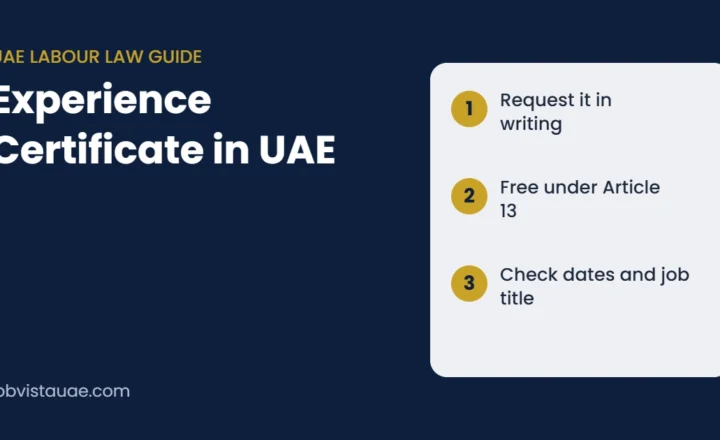
Also ask for your experience certificate. Article 13 says your employer must give you one free of charge when you ask. Your new employer may ask for it, and it is far easier to collect before you leave.
Step 5: Work permit cancellation and transfer, then your visa
On the mainland, a job change involves two authorities: MoHRE for the work permit and labour contract, and ICP or GDRFA Dubai for the residence visa and Emirates ID. The usual sequence is:
- Your old employer cancels your work permit with MoHRE. You sign to confirm that you agree and that you have received your dues, so check your settlement first.
- Your new employer applies for a transfer work permit. MoHRE requires the application “within 90 days of cancellation of the previous work permit.” MoHRE lists the service time as two working days.
- Your residence visa is handled. Your old residence visa is cancelled and your new employer arranges a new one. You can usually change status inside the UAE instead of exiting. The new employer must submit your employment contract to MoHRE within 14 days of the status change.
Watch the timing. The 90-day window applies to the work permit only. It does not extend your residence grace period, which for many categories is shorter. Our guide to employment visa cancellation lists grace periods by category and shows how to check your own date on official channels. The UAE work visa process guide explains how the new visa, medical test and Emirates ID are issued.
Step 6: Start your new job
Begin work only once the new work permit is issued in your new employer’s name. Check that the job title and salary on the registered contract match your signed offer. If you are covered by unemployment insurance, keep your subscription in order under the new employer. Our ILOE insurance guide explains the rules, including why a resignation does not qualify for a claim.
Which rules apply to you?
| Your situation | What applies |
|---|---|
| On probation, moving to another UAE employer | At least one month’s written notice (Article 9). Unless agreed otherwise, the new employer compensates your current employer for recruitment or contracting costs. |
| On probation, leaving the UAE | At least 14 days’ written notice. Leaving without following Article 9 can lead to a one-year ban on a new work permit, unless MoHRE grants an exemption. |
| After probation, mainland | Notice as agreed in your contract, between 30 and 90 days (Article 43). Settlement within 14 days (Article 53). New permit within 90 days of cancellation. |
| Free zone employee | Your free zone authority, not MoHRE, issues your work permit and visa and sets the transfer process. DIFC and ADGM have their own employment laws. |
If you are still on probation
Probation is where job moves go wrong most often. The notice rules above are minimums, and they apply right up to the last day of probation. The UAE Government portal’s page on the one-year work permit ban explains when the ban applies and when it starts. Our probation period in UAE guide covers the ban, the exemptions and the three-month return rule in full.
If you work in a free zone
The UAE Government portal’s page on recruiting in free zones says work permits and residence visas there are issued by the relevant free zone authority. It adds that free zone employees are generally covered by their free zone’s regulations together with the federal Labour Law, while DIFC and ADGM run their own employment frameworks. In practice, moving between two free zones, or between a free zone and the mainland, means one authority cancels and another issues. Ask both HR teams which authorities are involved before you agree a start date.
Non-compete clauses: when they can stop a move
A non-compete clause is legal in the UAE, but Article 10 of the Labour Law limits it tightly. It is only valid if:
- your work gave you knowledge of the employer’s clients or access to its work secrets
- it is written into the employment contract
- it is specific in time, place and type of work, only as far as needed to protect legitimate business interests
- it lasts no more than two years from the end of the contract
Article 10 also says the clause is void if the employer ends your contract in breach of the law. Article 12 of the Executive Regulation (Cabinet Resolution No. 1 of 2022) adds that the clause does not apply when:
- the contract ends because of the employer or its breach of legal or contractual obligations
- both sides agree in writing that it will not apply
- the contract ends during probation
- you or your new employer pay the previous employer compensation of no more than three months’ wage under your last contract, with the previous employer’s written approval
- you fall within occupational categories that MoHRE classifies as exempt
If a dispute goes to court, the employer has to prove the damage, and it must file within one year of discovering the breach. If your new role is with a direct competitor and your contract has a clause, get advice before you resign rather than after.
Mistakes to avoid when changing jobs in the UAE
- Leaving without serving notice. Your employer can claim the wage for the notice you did not serve, and an unresolved exit can delay your new permit.
- Starting work before the new permit is issued. Working for an employer that does not hold your permit is not a legal job, however friendly the arrangement.
- Simply stopping work. Unexcused absence can lead to a work-abandonment report. Our guide to absconding in UAE explains the consequences, including the one-year ban.
- Signing a new contract before your old permit is cancelled. MoHRE will not issue a transfer permit while your old one is active, so a start date set too early will slip.
- Signing the cancellation form before checking your dues. Your signature confirms you received your entitlements. Check the settlement line by line first.
- Paying anyone for a transfer. Do not pay an agent or “consultant” for a job, an NOC or a permit transfer. These costs belong to the employer.
If your employer ends the contract rather than you, our termination of employment in UAE guide explains what notice and pay you are owed.
Changing jobs in UAE: frequently asked questions
Do I need an NOC to change jobs in the UAE?
MoHRE’s transfer work permit requirements do not list an NOC from your current employer. The key document is the official MoHRE job offer signed by you and your new employer. Free zones set their own rules, so check with your free zone authority.
Can I change jobs during probation?
Yes, if you give at least one month’s written notice under Article 9. Unless agreed otherwise, your new employer compensates your current employer for recruitment or contracting costs.
Do I have to leave the UAE to change jobs?
Usually not. The official process lets a worker already in the UAE sign a new offer and change status inside the country. Your residence grace period still applies, so agree the timing with both employers.
How long does my new employer have to apply for my work permit?
MoHRE requires the new work permit application within 90 days of the previous permit’s cancellation. Your residence grace period may be shorter than that, so do not rely on the full 90 days.
Who pays for the new work permit and visa?
Your new employer. Article 6 of the Labour Law bars employers from charging workers recruitment and employment costs, directly or indirectly.
Plan the move before you resign
Changing jobs in the UAE is routine when the steps happen in the right order: signed MoHRE offer first, written resignation second, settlement checked before you sign, and a start date that fits both the 90-day permit window and your grace period. Keep copies of every document, and confirm anything unclear with MoHRE on 600 590000 before you act.
Looking for your next role? Browse the latest jobs in UAE or submit your CV to be considered for new vacancies.
This guide summarises Federal Decree-Law No. 33 of 2021 (available on the UAE Legislation portal), its Executive Regulation and MoHRE and u.ae pages as checked in October 2026. English versions are translations, and the Arabic text of UAE legislation prevails. It is general information, not legal advice. For your own situation, confirm with MoHRE or a qualified UAE employment lawyer.